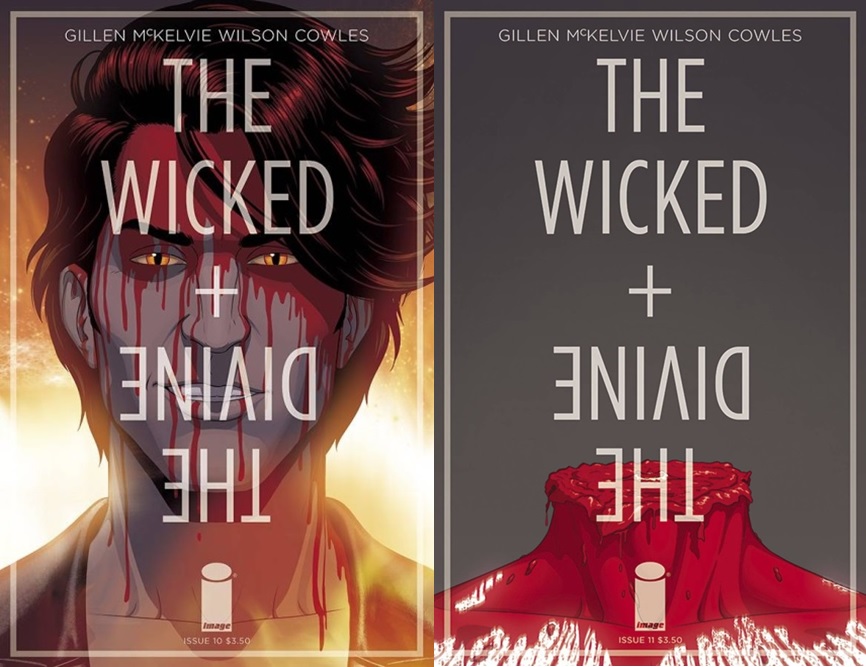
Showing posts with label Jamie McKelvie. Show all posts

October 9, 2015

The Wicked + The Divine Vol. 2 - Kieron Gillen & Jamie McKelvie

After death, comes mourning. And after the assassination of Lucifer, comes a bright new morning. But not for everyone. Laura is still frustrated, anxious and melancholic. For her, instead of the devil, Lucifer was a friend and a source of inspiration, as we saw in The Wicked + The Divine Vol. 1. “Human Trash” (published in The Wicked + The Divine # 6, December 2014) begins a month after Lucifer’s demise. Laura finds out that Inanna, perhaps the most flamboyant divinity of the pantheon, is investigating the murder. 
Jamie McKelvie
As usual, Jamie McKelvie’s art is quite spectacular. And it is also a bit different from what we have seen in the previous volume. McKelvie recovers the playfulness and freedom that made his Young Avengers run so memorable. “I can’t think of any other creative team that uses everything the medium offers to tell the story better than [Gillen and McKelvie]” affirms Peter Swanson, and I agree with him. 
Jamie McKelvie
In “Awkward Conversation” Kieron Gillen turns the typical comic convention into a celebration of divinity. Instead of a pantheon we have a fantheon, instead of readers we have worshippers, and instead of variant covers we have merchandise from the gods, including fast food franchises with the name of each one of the deities (Baal-You-Can-Eat-Buffet, Inanna and Out Burgers, Bap-O-Meat, The Val-Cakery, etc.). It’s quite revealing to see that ceremonies have been replaced by mere consumerism, and religious items have been substituted by good offers. If spirituality can be used as currency, then it loses all its meaning. However, this situation doesn’t seem to worry the young gods.
Jamie McKelvie
As a side note, I would like to mention Alison Sampson’s ludic guide to London’s Fantheon; more than a simple map, this is quite a creative narrative device that allow us to see how things are arranged in the Excell Centre giving us, at the same time, a sneak peek into Laura’s state of mind. The 12th god of the pantheon arrives in “Fear and Loathing in Eternity”, a charming chapter that finally sheds some lights on the origin of the gods and most especially Ananke’s role. Surprisingly, Baphoment unleashes his homicidal tendencies in “Not Her Story”.
Fantheon (Alison Sampson)
Of course, visual experimentation continues in “Night of the Living Godheads”, which emphasizes McKelvie’s audacity and innovative approach to storytelling. “Welcome to the party at the end of the world”, exclaims Dionysus. Laura has been invited by the god of wine to a youthful celebration in a place in which everything is permitted. Limits, then, are the ticklish subject here. Not only in terms of breaking the laws or being as irresponsible as only young people can be, but also in terms of physical resistance. For Laura, several hours of partying with the gods is more than her body can take. And thus, at some point, she must stop. Dionysus, suffering from sleep deprivation, admits that the party has been going on during two uninterrupted months. That sums up quite nicely Jacques Lacan’s imperative of jouissance –Enjoy! – enjoy without respite, enjoy to the death if you must, but enjoy. 
a party with the gods / una fiesta con los dioses
The imperative of jouissance also defines Inanna’s behavior: “Inanna’s after-parties are legendary. People kill for an invite. Sex with the volume turned up”. In these wild orgies, joy is taken to the extreme, until it becomes the painful preamble of death. Finally, in “It Was Never Going to Be Okay”, Ananke turns Laura into the goddess Persephone, but instead of a blessing this will be a dangerous curse. In fact, I must say the ending was completely unexpected. And I’m sure that volume 3 of WicDiv will have even greater surprises.
________________________________________________________________________________________________
________________________________________________________________________________________________

Después de la muerte, viene el luto. Y después del asesinato de Lucifer, llega un nuevo día. Pero no para todos. Laura sigue frustrada, ansiosa y melancólica. Para ella, en lugar del diablo, Lucifer era una amiga y una fuente de inspiración, como vimos en The Wicked + The Divine Vol. 1. “Basura humana” (publicado en “The Wicked + The Divine” # 6, diciembre de 2014) comienza un mes después del deceso de Lucifer. Laura descubre que Inanna, tal vez la divinidad más extravagante del panteón, está investigando el asesinato.
war of the gods / la guerra de los dioses

Como de costumbre, el arte de Jamie McKelvie es bastante espectacular. Y también es un poco distinto a lo que vimos en el volumen anterior. McKelvie recupera la ingeniosidad y la libertad que hicieron tan memorable su etapa en Young Avengers.  “No puedo pensar en ningún otro equipo creativo que utilice todo lo que ofrece el medio para contar una historia mejor que [Gillen y McKelvie]” afirma Peter Swanson, y estoy de acuerdo con él.

En “Conversación incómoda” Kieron Gillen convierte a la típica convención de cómics en una celebración de la divinidad. En lugar de un panteón tenemos un fanteón, en lugar de lectores tenemos adoradores, y en lugar de portadas variantes tenemos mercancía de los dioses, incluyendo franquicias de comida rápida con los nombres de cada una de las deidades (Buffet todo-lo-que-Baal-puede comer, Hamburguesas Inanna and Out, Bap-O-Meat, The Val-Cakery, etc.). Es muy revelador ver que las ceremonias han sido reemplazadas por mero consumismo y los artículos religiosos han sido sustituidos por las buenas ofertas. Si la espiritualidad se puede utilizar como una moneda, entonces pierde todo su significado. Sin embargo, esta situación no parece preocupar a los jóvenes dioses.

Como nota al margen, me gustaría mencionar la guía lúdica de Alison Sampson del Fanteón de Londres; más que un simple mapa, este es un creativo recurso narrativo que nos permite ver la ubicación y disposición del Centro Excell; y al mismo tiempo vemos de reojo el estado mental de Laura. El decimosegundo dios del panteón llega en “Miedo y asco en la eternidad”, un encantador capítulo que finalmente arroja algunas luces sobre el origen de los dioses y, muy especialmente, sobre el papel de Ananké. Sorprendentemente, Baphoment desata sus tendencias homicidas en “No es su historia”.
Ananke & Persephone
a perpetual orgy / una orgía perpetua
Por supuesto, la experimentación visual continúa en “La noche de los dioses vivientes”, la audacia de McKelvie aumenta y su enfoque visual es innovador. “Bienvenidos a la fiesta en el fin del mundo”, exclama Dionisio. Laura ha sido invitada por el dios del vino a una celebración juvenil en un lugar en el que todo está permitido. Los límites, entonces, son un tema espinoso. No sólo en términos de romper las leyes o ser tan irresponsable como sólo los jóvenes pueden llegar a ser, sino también en términos de la resistencia física. Para Laura, varias horas de fiesta con los dioses es más de lo que su cuerpo puede aguantar. Y así, en algún momento, ella debe tomar una pausa. Dionisio, que sufre de insomnio crónico, admite que la fiesta ha durado durante dos meses ininterrumpidos. Eso resume bastante bien el imperativo al goce de Jacques Lacan -¡Goza! Goza sin descanso, goza hasta la muerte si es necesario, pero goza.

El imperativo al goce también define el comportamiento de Inanna: “las juergas de Inanna son legendarias. La gente mata por una invitación. Es sexo con el volumen al máximo”. En estas orgías salvajes, el goce es llevado al extremo, hasta que se convierte en el preámbulo doloroso de la muerte. Por último, en “Las cosas nunca iban a salir bien”, Ananké convierte a Laura en la diosa Perséfone, pero en lugar de una bendición esta será una peligrosa maldición. De hecho, debo decir que el final fue completamente inesperado. Y seguramente en el volumen 3 de “WicDiv” habrá aún mayores sorpresas.

February 4, 2015

The Wicked + The Divine # 1-5 - Kieron Gillen & Jamie McKelvie

The boy to my right falls to his knees, cum leaking from his crotch”, the girls fade out, hyperventilating, it’s the perfect orgasm, it’s what a total orgasm should feel like, and the only one who resists such an intense input of pleasure is Laura, a 17-year-old girl who loves the new and old gods that now walk upon the Earth: Amaterasu, Lucifer and the others, barely teenagers who claim to be the living incarnations of the most ancient divinities in the history of humankind.

But these gods and goddesses are not here to reenact empty rituals or demand reverence. On the contrary, they’re here to shine, brighter than the Apollonian sun, and to cast a shadow as deep as the Erebus night. They’re here to rock, they’re here to be pop idols, and their cult following is just beginning to increase.

“Once Again” (June 2014) is the first chapter of this magnificent exercise of creativity, brought to us by two of my favorite British authors: Kieron Gillen and Jamie McKelvie. They had already dealt with the difficult transit from adolescence to youth in the pages of 2013’s best ongoing series: “Young Avengers”. And now they’re back, reaffirming their indy roots, paying homage to other deities, making us remember that “Phonogram” is not over yet.

In “The No-Pinkie Pinkie Swear”, we see Laura trying to find Ananke “the absolute ruler of all destiny and fate, for both gods and mortals”. Nevertheless, Lucifer has another mission for Laura. As we’ve seen before, all gods are pop stars, worldwide famous, extremely popular figures, teen idols with millions of followers. Except for the Morrigan, an underground divinity that is always hard to find. “I’ve seen all the gods… except the Morrigan”, explains Laura.

“Chthonic Homesick Blues” explores even further the nature of these teenagers turned into gods; and how they rely on popularity and fans instead of orthodox worshipping; because the young deities never set foot on a temple but rather on the stages of hugely publicized concerts. In “The Immoral of the Tale”, Laura has the opportunity to visit Woden’s (Odin) Valhalla and meet the rest of the pantheon: Sakhmet, Minerva, Ananke, Baal and Amaterasu. Finally, in “Sympathy”, Lucifer is murdered in cold blood by Ananke. Her death is an unexpected plot twist, and it puts even more weight onto Laura’s shoulders.
Lucifer & Laura

Perhaps one of the greatest virtues of this new series is how it works as a “spiritual successor” to Young Avengers. As Joe Drake explains “If YA was high school, where you’ve got a specific end goal (graduate, get into a good school, etc.), WicDiv strikes me as the reeling period that comes next, whether you’re in college, working a job, or travelling”. Indeed, I also feel as if WicDiv is that amazing and yet completely chaotic transitional period between the high school era and the “what comes next?” moment that defines the lives of young adults.

At the end of “The Faust Act”, Laura understands the motivations of the gods better than ever. At the same time, the pantheon must mourn the loss of one of their own. As Gillen explains in the epilogue “Death sits there waiting, without even the polite offer of a game of chess before unceremoniously showing you the exit […] The question becomes how do you choose to spend that infinitely brief, precious time?”. 

Fresh and vibrant, the art of Jamie McKelvie becomes the ideal ally to Gillen’s scripts. McKelvie is so perfectly suited to draw young people that his pages add on to the juvenile energy of The Wicked + The Divine. I already had the pleasure of admiring his lines in the pages of Young Avengers, and here we can also welcome his creative character designs. I’m absolutely convinced that the second arc will be just as good as this one. 
________________________________________________________________________________________________
________________________________________________________________________________________________
The head of the Morrigan / la cabeza de Morrigan

El chico a mi derecha cae de rodillas, el semen se chorrea por su entrepierna”, las chicas se desmayan, hiperventilando, es el orgasmo perfecto, es el orgasmo total, y la única capaz de resistir un placer tan intenso es Laura, una chica de 17 años que adora a los nuevos y viejos dioses que ahora caminan por la Tierra: Amaterasu, Lucifer y los demás, apenas adolescentes que claman ser las encarnaciones vivientes de las más antiguas divinidades en la historia de la humanidad.

Pero estos dioses y diosas no están aquí para recrear rituales vacíos o demandar reverencias. Por el contrario, están aquí para brillar, más luminosos que el sol de Apolo, y para proyectar una sombra tan profunda como la noche del Erebo. Están aquí para el rock, para ser ídolos pop, y el número de sus seguidores va en aumento. 

“Una vez más” (junio de 2014) es el primer capítulo de este magnífico ejercicio de creatividad, elaborado por dos de mis autores británicos favoritos: Kieron Gillen y Jamie McKelvie. Ellos ya habían lidiado con el difícil tránsito de la adolescencia a la juventud en las páginas de la mejor serie mensual del 2013: “Young Avengers”. Y ahora están de vuelta, reafirmando sus raíces independientes, rindiendo homenaje a otras deidades, haciéndonos recordar que “Phonogram” aún no ha terminado. 

En “El no juramento del dedo meñique”, vemos a Laura intentando encontrar a Ananke “la que domina absolutamente todo el destino tanto para dioses como para mortales”. No obstante, Lucifer tiene otra misión para Laura. Como hemos visto antes, todos los dioses son estrellas pop, mundialmente famosos, figuras extremadamente populares, ídolos juveniles con millones de seguidores. Excepto Morrigan, una divinidad 'underground' que siempre es difícil encontrar. “He visto a todos los dioses… excepto a Morrigan”, explica Laura.
Valhalla

“Blues nostálgico Chthonico” explora aún más la naturaleza de estos adolescentes convertidos en dioses; y cómo se apoyan en la popularidad y en sus fans en vez de en la adoración ortodoxa; porque las jóvenes deidades nunca ponen un pie en un templo sino más bien en los escenarios de conciertos precedidos de muchísima publicidad. En “Lo inmoral del relato”, Laura tiene la oportunidad de visitar el Valhala de Woden (Odín) y conocer al resto del panteón: Sakhmet, Minerva, Ananke, Baal y Amaterasu. Finalmente, en “Simpatía”, Lucifer es asesinada a sangre fría por Ananke. Su muerte es un inesperado giro argumental, y pone aún más peso sobre los hombros de Laura.
The death of Lucifer / la muerte de Lucifer

Tal vez una de las grandes virtudes de esta nueva colección es que funciona como un “sucesor espiritual” de Young Avengers. Como explica Joe Drake “Si YA era la secundaria, en donde tienes una meta final específica (graduarte, entrar a una buena universidad, etc.), me parece que WicDiv es el periodo vacilante que viene a continuación, ya sea que estés en la universidad, trabajando, o viajando”. De hecho, yo también siento que WicDiv es ese periodo de transición asombroso y no obstante completamente caótico entre la época de la secundaria y el momento que viene después, que define las vidas de los jóvenes adultos.

Al final de “El acto de Fausto”, Laura entiende las motivaciones de los dioses mejor que antes. Al mismo tiempo, el panteón debe llorar la pérdida de uno de los suyos. Como explica Gillen en el epílogo “La muerte se sienta allí, esperándote, ni siquiera con un amable ofrecimiento de un juego de ajedrez antes de mostrarte la salida sin ceremonia alguna […] La pregunta se convierte en ¿cómo eliges gastar ese infinitamente breve y precioso tiempo?”. 

Fresco y vibrante, el arte de Jamie McKelvie es el aliado ideal para los guiones de Gillen. McKelvie es la opción perfecta para dibujar a jóvenes, y sus páginas suman energía juvenil a The Wicked + The Divine. Ya había tenido el placer de admirar sus trazos en las páginas de Young Avengers, y aquí también podemos darle la bienvenida a sus creativos diseños de personajes. Estoy absolutamente convencido de que el segundo arco será tan bueno como este.

February 10, 2014

Young Avengers # 15 - Gillen, McKelvie & more

Quite often we assume a cynical posture towards contemporary comic books. We criticize decompression, reiterative exploitation of a certain brand or group of characters, predictability, publicity stunts, lack of creative freedom as a result of editorial impositions, etc. Some might even come to believe that no good comics are produced in Marvel (and DC) due to the current atmosphere of editorial-mandated mega-events. That conclusion, however, would be utterly wrong.

I have read hundreds of comics last year, from every publisher, and although I have enjoyed the proposals of independent creators working outside the big two, what I loved the most, without a doubt, was Kieron Gillen’s Young Avengers. The best of 2013 comes, indeed, from Marvel.

Upon reading “Resolution part 2”, the final issue, I felt an unexpected sadness. The end awakened in me a strong melancholy, that last page, beautifully illustrated by Jamie McKelvie was like a statement about youth and friendship. It was a snapshot, a captured instant, a moment in the lives of the Young Avengers. And it was also a moment in my life. Looking at them and saying goodbye to them made me go through an experience I’m quite familiar with: the sensation of loss I have experienced every time a friend of mine decides to go to another country or another continent; most of the times I expect them to return after a couple of years, sometimes, however, they never come back. And I know then that, despite all apparent opportunities, I’ll never see them again. That is a very special kind of goodbye. They are within reach, at least theoretically, but they are no longer a part of my life.

In a few years, the Young Avengers might return, but they could very well stay in limbo longer than we could possibly anticipate. So yes, it was deeply painful to read the end of this fantastic ongoing series. And now I find myself here, saying goodbye to a group of fictional characters with a heavy heart, almost as if they were real persons going away for a while. That’s the power of good literature and that’s the accomplishment of Gillen. Turning a group of superpowered kids into characters that you will always care for, characters that you can identify with, characters that will make you feel young again.

But we must embrace change and move on. Marvel Boy finally understands that, now that he has ruined his relationship with Kate Bishop. Gillen gives us one final glimpse into the minds and souls of the Young Avengers. If in the previous issues we had the original members on the spotlight, now it’s time to pay attention to Marvel Boy and his silent agony. It’s also time to observe Loki not only as the god of mischief but also as a lonely teenager that feels forced to be in charge of the “dirty work”, the things that need to be done and that most of us never acknowledge appropriately. It is Loki who pays, with the treasure of Asgard, for the organization of the party, who makes sure the catering people receive a proper compensation for working through New Year’s Eve.
Becky Cloonan

David Alleyne (Prodigy) still feels a bit guilty about kissing Teddy and incurring in Billy’s wrath. “You just let the party that lurks in the pants undue prominence in the parliament of prodigy”, affirms Loki. And as the two teenagers talk, David discovers that Loki isn’t 100% heterosexual “my culture doesn’t really share your concept of sexual identity. There are sexual acts, that’s it”, explains the Norse deity. Either as a joke or as a serious attempt at flirtation, Loki proposes a special celebration with David. The young mutant kindly refuses alleging Loki isn’t his type. Before disappearing into the night Loki asks David what’s his type. “Good guys”, he answers cheerfully.

Later on, after David accidentally kisses Tommy, we understand how the discovery of sexuality can be life-defining in youth, and how difficult it is to find a comic in the 21st century that will discuss the matter audaciously and intelligently. Young Avengers is a title of historical significance because it’s the first superhero comic to fully embrace the diversity of sexual orientations and the only 100% GLBT American mainstream book.

Jokes aside, if we take a look at the group we might consider the following attributes: Ms. America is lesbian, Prodigy is bisexual, Marvel Boy is pansexual (he will have sex with human males and females, as well as with aliens of all shapes and sizes), Hulkling is homosexual, Wiccan is homosexual, Loki is transsexual (we have seen him as a woman and using his/her feminine charms to seduce men during Straczyinki’s run on Thor), Speed is bi-curious and Kate Bishop is the only heterosexual member of the team. 

The Young Avengers finale was conceived as a jam special, and this time we get to see the drawings of Becky Cloonan (in charge of portraying a brooding Marvel Boy), Ming Doyle (her depiction of Loki is quite good) and Joe Quinones (who contributes with a lot of humor in Prodigy’s sequence, including the kiss with Tommy). 

In the letter column, many fans talk about how frustrated they feel now that the title has come to an end. I do not feel frustration, because I truly think that Gillen and McKelvie did the best comic I’ve read in years, and none of it would have been possible with editorial interference or the obsessive desire of endlessly milking the same property… a common practice in the big two.
Ming Doyle

Gillen and McKelvie are very thankful to us, the readers. And I’m very thankful to those who made the book possible: Kieron Gillen, Jamie McKelvie, Annie Wu, Becky Cloonan, Bryan Lee O’Malley, Christian Ward, Clayton Cowles, David LaFuente, Emma Vieceli, Hannah Donovan, Idette Winecoor, Jake Thomas, Allan Heinberg, Jim Cheung, Joe Quinones, Jordie Bellaire, Kate Brown, Kris Anka, Lee Loughridge, Manny Mederos, Maris Wicks, Matthew Wilson, Mike Norton, Ming Doyle, Morry Hollowell, Nathan Fairbairn, Skottie Young, Stephanie Hans, Stephen Thompson, Tradd Moore, and editor Lauren Sankovitch and assistant editor Jon Moisan.

I would also like to congratulate those who shared their secrets, fears, joys and dreams in the letter columns. I have felt really moved by those who wrote in to talk about their lives, and how they struggle against bullying, homophobia and discrimination, if some of them found inspiration on the pages of this book, then the journey has not been in vain. So a big thank you to Reed Beebe, Wally, Brad, Steven Roche, Avery, Hansel, Chuck McKinney, Matt Brooks, Graham Weaver, Amanda, Mason, Steven Butler, Patrick Bartlett, Jonathan Robbins, Mia, Saul Santos, Arcadio Bolaños (yay! that’s me! now click here to read my letter), Jack Ingram, Carlos Aguirre Reyna, Lauren, Becky Male, Izrin Iskandar, Brennan O’Reagan, Zamisk, Joe Douglas, Kami Spangler, Calvin, Trent Farrell, Lyn, Carlton Glassford, Oliver Ortiz, Michael J. Allen, Indie Gale, Clarissa Johnson, Niamh, Souxie, Regina Belmonte, Rachel Yu, Thomas Rowley, Chiara, James Hunter, Bridget Natale, Andy E, Connor Stephenson, C. Morgan Leigh, Zae, Sara Hanley, Lucy, Jacques Farnworth-Wood, Maximillian Jansen, Day Summerfield, Amanda, George Laporte, Christian Hernandez, Rachael, Niels van Eekelen, Sarah Urbank, Lawrence, Summer, Rebecca Luttig, Jack Davis, Rob Rix, Miles PDX, Mikey J. Redd, Carey & Brandon.

Young Avengers has been the kind of honest, personal and tremendously creative project that will be forever remembered in comic history. And I’m very proud to say that, however briefly, I was a part of it. I was there. And I fucking loved it.

Young Avengers # 11, Young Avengers # 12, Young Avengers # 13 & Young Avengers # 14

Young Avengers # 1-10
_________________________________________________________________________________________________
_________________________________________________________________________________________________

A menudo asumimos una postura cínica en relación a los cómics contemporáneos. Criticamos la poca cohesión, explotación reiterativa de ciertas marcas o grupos de personajes, predictibilidad, trucos de publicidad, falta de libertad creativa como resultado de las imposiciones editoriales, etc. Algunos incluso podrían creer que no hay buenos cómics en Marvel (ni en DC) a causa de la actual atmósfera de mega-eventos mandados por la editorial. Esa conclusión, sin embargo, sería totalmente errónea.
Joe Quinones

He leído cientos de cómics el año pasado, y aunque he disfrutado las propuestas de creadores independientes que trabajan alejados de Marvel y DC, lo que más me encantó, sin duda alguna, fue Young Avengers de Kieron Gillen. Lo mejor del 2013 es de Marvel.

Luego de leer “Resolución parte 2”, el número final, sentí una inesperada tristeza. El final despertó en mí una fuerte melancolía, esa última página, hermosamente ilustrada por Jamie McKelvie era como una declaración sobre la juventud y la amistad. Era una instantánea, un momento capturado, un segundo en las vidas de los Jóvenes Vengadores. Y también era un momento en mi vida. Mirándolos y despidiéndome de ellos, fue como experimentar algo que me resulta muy familiar: la sensación de pérdida que he sentido cada vez que un amigo decide irse a otro país o a otro continente; la mayoría de las veces, espero que regresen luego de un de par de años, a veces, sin embargo, nunca vuelven. Y entonces sé que, a pesar de todas las oportunidades, nunca más los veré de nuevo. Ese tipo de despedidas es muy especial. No han desparecido, al menos teóricamente, pero ya no son parte de mi vida.

En algunos años, los Jóvenes Vengadores podrían regresar, pero bien podrían quedarse en el limbo más tiempo de lo que posiblemente podríamos anticipar. Así que fue profundamente doloroso leer el final de esta fantástica serie mensual. Y ahora estoy aquí, acongojado, casi como si se tratara de personas de verdad que estarán lejos por un tiempo. Ese es el poder de la buena literatura y ese es el logro de Gillen. Convertir a un grupo de chiquillos con poderes en personajes a los que siempre apreciarás, personajes con los que te identificas, personajes que te hacen sentir joven nuevamente. 

Pero debemos aceptar el cambio y seguir avanzando. Marvel Boy finalmente lo entiende, ahora que ha arruinado su relación con Kate Bishop. Gillen nos da un último vistazo a las mentes y almas de los Jóvenes Vengadores. Si en números anteriores los miembros originales estaban al centro del escenario, ahora es el momento de prestarle atención a Marvel Boy y a su agonía silenciosa. También es tiempo de observar a Loki no sólo como el dios de los enredos sino también como un adolescente solitario que se siente obligado a encargarse del “trabajo sucio”, las cosas que necesitan hacerse aunque no les demos el reconocimiento adecuado. Es Loki quien paga, con el tesoro de Asgard, la organización de la fiesta, quien se encarga de que la gente del catering reciba una compensación apropiada por trabajar en año nuevo.
Joe Quinones

David Alleyne (Prodigy) todavía se siente un poco culpable por besar a Teddy e incurrir en la ira de Billy. “Tan sólo le permitiste a la fiesta que acecha en tus pantalones una indebida prominencia en el parlamento del prodigio”, afirma Loki. Y mientras los dos adolescentes conversan, David descubre que Loki no es 100% heterosexual “mi cultura realmente no comparte tu concepto de identidad sexual. Hay actos sexuales, eso es todo”, explica la deidad nórdica. Ya sea como una broma o un intento serio de flirtear, Loki le propone a David una celebración especial. El joven mutante amablemente rehúsa alegando que Loki no es su tipo. Antes de desaparecer en la noche, Loki le pregunta a David cuál es su tipo. “Los chicos buenos”, responde alegremente.

Más tarde, después de que David besa accidentalmente a Tommy, entendemos cómo el descubrimiento de la sexualidad puede definir la vida de los jóvenes, y vemos lo difícil que es encontrar un cómic en el siglo XXI que discuta el tema inteligente y audazmente. "Young Avengers" es un título de relevancia histórica porque es el primer cómic que acepta por completo la diversidad de orientaciones sexuales y el único cómic de distribución masiva es que es 100% GLBT.

Bromas aparte, si echamos un vistazo al grupo podríamos considerar los siguientes atributos: Ms. America es lesbiana, Prodigy es bisexual, Marvel Boy es pansexual (tendrá sexo con humanos, masculinos y femeninos, así como con aliens de todas las formas y tamaños), Hulkling es homosexual, Wiccan es homosexual, Loki es transexual (lo hemos visto como una mujer y usando sus encantos femeninos para seducir hombres durante la etapa de Straczyinki en Thor), Speed es bi-curioso y Kate Bishop es la única integrante heterosexual del equipo.

El final de Young Avengers se concibió como algo colaborativo, y esta vez vemos los dibujos de Becky Cloonan (a cargo de retratar a un cabizbajo Marvel Boy), Ming Doyle (su retrato de Loki es bastante bueno) y Joe Quinones (quien contribuye con humor en la secuencia de Prodigy, incluyendo el beso con Tommy). 
Last page, final issue / última página, número final

En la sección de cartas, muchos fans comentaron lo frustrados que se sentían ahora que el título llegaba a su fin. Yo no siento frustración, porque realmente pienso que Gillen y McKelvie hicieron el mejor cómic que he leído en años, y nada de esto hubiese sido posible con interferencias editoriales o el deseo obsesivo de ordeñar eternamente un mismo producto... una práctica común en Marvel y DC.

Gillen y McKelvie nos agradecen a nosotros, los lectores. Y yo le doy las gracias a aquellos que hicieron posible esta colección: Kieron Gillen, Jamie McKelvie, Annie Wu, Becky Cloonan, Bryan Lee O’Malley, Christian Ward, Clayton Cowles, David LaFuente, Emma Vieceli, Hannah Donovan, Idette Winecoor, Jake Thomas, Allan Heinberg, Jim Cheung, Joe Quinones, Jordie Bellaire, Kate Brown, Kris Anka, Lee Loughridge, Manny Mederos, Maris Wicks, Matthew Wilson, Mike Norton, Ming Doyle, Morry Hollowell, Nathan Fairbairn, Skottie Young, Stephanie Hans, Stephen Thompson, Tradd Moore, y la editora Lauren Sankovitch y el editor asistente Jon Moisan.

También quisiera felicitar a aquellos que compartieron sus secretos, sus miedos, sus alegrías y sus sueños en la sección de cartas. Realmente me he sentido conmovido por aquellos que escribieron para hablar de sus vidas, y su lucha contra los abusos, la homofobia y la discriminación, si alguno de ellos encontró inspiración en las páginas del cómic, entonces el viaje no fue en vano. Así que muchas gracias a Reed Beebe, Wally, Brad, Steven Roche, Avery, Hansel, Chuck McKinney, Matt Brooks, Graham Weaver, Amanda, Mason, Steven Butler, Patrick Bartlett, Jonathan Robbins, Mia, Saul Santos, Arcadio Bolaños (¡sí, ese soy yo! hagan click aquí para leer mi carta), Jack Ingram, Carlos Aguirre Reyna, Lauren, Becky Male, Izrin Iskandar, Brennan O’Reagan, Zamisk, Joe Douglas, Kami Spangler, Calvin, Trent Farrell, Lyn, Carlton Glassford, Oliver Ortiz, Michael J. Allen, Indie Gale, Clarissa Johnson, Niamh, Souxie, Regina Belmonte, Rachel Yu, Thomas Rowley, Chiara, James Hunter, Bridget Natale, Andy E, Connor Stephenson, C. Morgan Leigh, Zae, Sara Hanley, Lucy, Jacques Farnworth-Wood, Maximillian Jansen, Day Summerfield, Amanda, George Laporte, Christian Hernandez, Rachael, Niels van Eekelen, Sarah Urbank, Lawrence, Summer, Rebecca Luttig, Jack Davis, Rob Rix, Miles PDX, Mikey J. Redd, Carey y Brandon.

"Young Avengers" ha sido el tipo de proyecto honesto, personal y tremendamente creativo que será recordado para siempre en la historia de los cómics. Y estoy muy orgulloso de decir que, aunque brevemente, yo también fui parte de ello. Yo estuve allí. Y eso es jodidamente genial.


January 23, 2014

Young Avengers # 14 - Gillen, McKelvie, Vieceli, Ward & Wu

When the effervescence of youth erupts there is only one suitable solution: Party like there is no tomorrow! And that’s exactly what the Young Avengers do after saving the universe. They throw the biggest ‘we saved the universe and it’s New Year’ party ever. But it’s not just a simple annual tradition; they are alive and they are celebrating that. It’s both exultant and scary to realize how fleeting life can be for these youngsters, who face not only the cruelest villains but also their own insecurities and fears.

As Kieron Gillen affirms “This is a book about the end of the universe”; but unlike most Marvel (or DC) books, here the biggest threat comes from within: we are our worst enemies. Gillen’s run is characterized by “using the characters' emotional lives as a solution to the problem”. And after one year of groundbreaking stories and unexpected plot twists, all things have fallen into place.

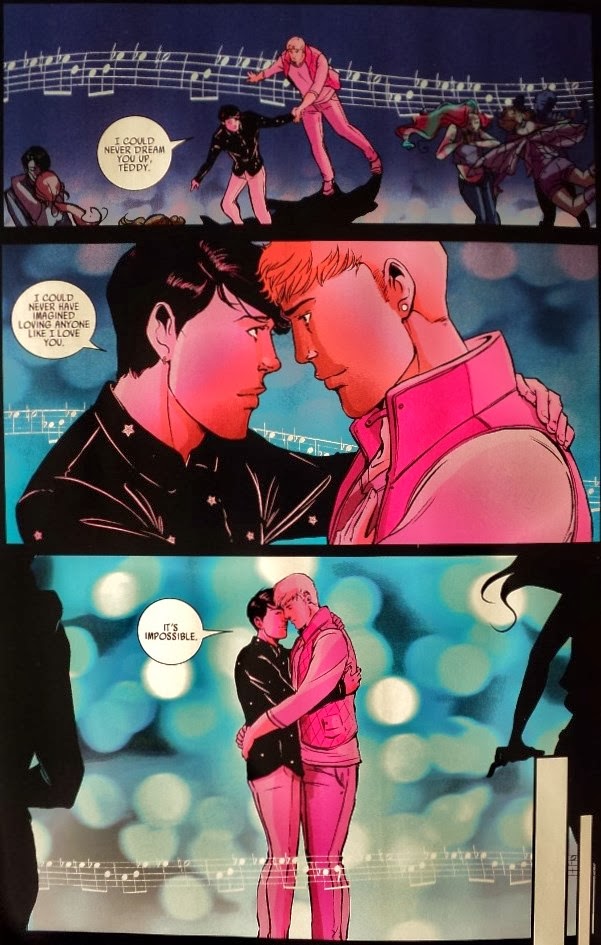
“Resolution part 1” gives us a glimpse of New Year’s Eve. And in a few pages we understand the relevance of “romantic love and how it affects people, and responsibility, both in terms of growing up and being a hero”. The Young Avengers set up on a long journey at the beginning of the series, and only now do they have the time to take a breath and process what has happened to them. Loki is gone. And without him, his lies have lost all meaning. Hulkling no longer believes he was ‘wished into existence’ by Wiccan’s reality altering powers. When Billy and Teddy are dancing together, the wizard tells his boyfriend that he needn’t worry: “I could never dream you up Teddy. I could never have imagined loving anyone like I love you”.  
Jamie McKelvie: the party begins / Jamie McKelvie: la fiesta comienza

Nevertheless, love’s victory is never guaranteed. “Love fails because the other person is in love with the reality of an earlier love, to the point where they almost don't care about anything else. Marvel Boy dumps Kate for the idea of an old girlfriend that doesn't really exist”. And a relationship that started in the first issue of this series comes to a bitter end during this final chapter. 
Emma Vieceli: young heroes in love / jóvenes héroes enamorados

The after party sequences are beautifully illustrated by Jamie McKelvie (his double page spread is magnificent); the moment of intimacy between Billy and Teddy is aptly depicted by Emma Vieceli; Christian Ward is responsible for the colorful sequences dedicated to Ms. America; and at last, but certainly not least, Annie Wu draws Kate Bishop pages. Immediately after breaking up with Marvel Boy, Kate decides to dance with Tommy Shepherd (AKA Speed).

Wu’s final splash page is admirable for two reasons: because it faithfully captures the youthfulness and pure joy of the kids; and because it’s also a wonderful homage to Bryan Lee O’Malley’s variant cover for Young Avengers # 1. In this prophetic cover, published 1 year ago, Kate Bishop is dancing with Tommy, while Teddy tenderly touches Billy. At midnight, the young heroes are as happy as they should be. There are only two missing characters here: Marvel Boy –who probably regrets having ruined his relationship with Kate– and Loki –neither a child, nor an adult, the god of lies is now destined to become an agent of Asgard. 

“This is how we think comics could be in this genre in 2013. Take what you like and leave what you don't. And enough of it worked to make me happy with it”, has expressed Gillen. But honestly, I can’t think of a single aspect or element about this book that I haven’t loved, except for the fact that it is ending. But I respect Gillen’s decision, he “did manage to do a big pop statement comic at a major comics publisher to enormous acclaim”. And that certainly deserves a standing ovation. 
_________________________________________________________________________________________________
_________________________________________________________________________________________________
Annie Wu: Kate Bishop and Marvel Boy break up /
Kate Bishop y Marvel Boy rompen

Cuando la efervescencia de la juventud estalla hay una solución adecuada: una juerga absoluta. Y eso es exactamente lo que hacen los Jóvenes Vengadores después de salvar el universo. Con una gran fiesta, ellos celebran el año nuevo y también haber salvado el universo. Pero no es una simple tradición anual; ellos están vivos y eso es lo que celebran. Es exultante pero también terrorífico observar lo fugaces que pueden ser las vidas de estos jovencitos quienes no sólo se enfrentan a crueles villanos sino también a sus propias inseguridades y miedos. 

Tal como afirma Kieron Gillen “Esta es una serie sobre el fin del universo”; pero a diferencia de la mayoría de títulos de Marvel (o DC), aquí la amenaza más grande viene de adentro: nosotros somos nuestros peores enemigos. La etapa de Gillen está caracterizada por “usar las vidas emocionales de los personajes como una solución al problema”. Y después de un año de historias innovadoras y giros argumentales inesperados, todo cae en su sitio.

“Resolución parte 1” nos da un vistazo a la noche de año nuevo. Y en pocas páginas entendemos la relevancia del “amor romántico y cómo afecta a la gente, y la responsabilidad, en términos de crecer y ser un héroe”. Los Jóvenes Vengadores se embarcaron en una travesía al inicio de la serie, y recién ahora tienen tiempo de tomar aliento y procesar lo que les ha pasado. Loki se ha ido. Y sin él, sus mentiras han perdido todo significado. Hulkling ya no cree que fue 'creado' por los poderes alteradores de la realidad de Wiccan. Cuando Billy y Teddy bailan juntos, el hechicero le dice a su enamorado que no necesita preocuparse: “Nunca podría inventarte en mis sueños, Teddy. Nunca podría haber imaginado amar a alguien tanto como te amo a ti”.  


Wonderful homage to Bryan Lee O’Malley's cover /
maravilloso homenaje a la portada de de Bryan Lee O’Malley
No obstante, la victoria del amor nunca está garantizada. “El amor fracasa porque la otra persona está enamorada con la realidad de un primer amor, al punto que casi no les importa ninguna otra cosa. Marvel Boy rechaza a Kate por la idea de una antigua enamorada que no existe realmente”. Y una relación que empezó en el primer número de la serie llega a su amargo final durante este último capítulo. 

Las secuencias de la fiesta están hermosamente ilustradas por Jamie McKelvie (su página doble es magnífica); el momento de intimidad entre Billy y Teddy está apropiadamente retratado por Emma Vieceli; Christian Ward es el responsable de las coloridas secuencias dedicadas a Ms. America; y por último, Annie Wu dibuja las páginas de Kate Bishop. Inmediatamente después de romper con Marvel Boy, Kate decide bailar con Tommy Shepherd (Speed).

La página final de Wu es admirable por dos razones: porque captura fielmente la juventud y el goce total de los chiquillos: y porque también es un maravilloso homenaje a la portada variante de Bryan Lee O’Malley para Young Avengers # 1. En esta profética portada, publicada hace 1 año, Kate Bishop está bailando con Tommy, mientras que Teddy acaricia a Billy tiernamente. A la medianoche, los jóvenes héroes están tan felices como deberían. Sólo faltan dos personajes: Marvel Boy –que probablemente se arrepienta por haber arruinado su relación con Kate– y Loki –ya no es un niño pero tampoco un adulto, el dios de las mentiras está destinado a convertirse en un agente de Asgard. 

“Así es como pensamos que podrían ser los cómics en este género, en el 2013. Toma lo que te guste y deja lo que no te guste. Y buena parte de ello funcionó para hacerme feliz”, ha expresado Gillen. Pero honestamente, no puedo pensar en un sólo aspecto o elemento de la colección que no me haya encantado, excepto por el hecho de que está terminando. Pero respeto la decisión de Gillen, quien se las “arregló para hacer una gran declaración pop de cómic en una gran editorial de cómics, con una enorme aclamación”. Y ciertamente eso merece que aplaudamos de pie.

January 17, 2014

Young Avengers # 13 - Kieron Gillen & Jamie McKelvie

One day, walking down the street, attending classes, going to your office, or simply having fun at a party, you fall in love. It doesn’t matter who you fall in love with. What counts is that suddenly, for one hour, one week or one year you find someone else, someone that inspires you and complements you. You find someone to love. And that’s no easy feat.

When Kieron Gillen and Jamie McKelvie decided to reinvent Marvel’s most notable juvenile team, they focused exactly on that idea. Finding someone else, and holding on to him or her, for as long as possible, no matter what. And yet, in the pages of “The Kiss and the Make-Up”, Billy Kaplan and Teddy Altman come to a hard and painful realization: they can no longer be a couple. And they break up.

In subsequent issues, Mother, an inter-dimensional demon reunites an army of –you guessed it alright– former boyfriends and girlfriends of the Young Avengers. In one way or another, the failure of love symbolizes a prophecy of universal doom. 

And Loki’s mischievous plots provoke the deterioration of Hulkling and Wiccan’s relationship. Finally, Loki admits his treachery and explains how he had been manipulating everyone since the beginning of the series. It’s sad to see that now Kid Loki –and therefore his naïve and innocent aspect– is gone; Teen Loki has no hope of redemption.


Alex Power (from Power Pack) / Alex Power (de Power Pack)
When Marvel Boy declares he is more into the bondage-sadomasochism elements embodied by Oubliette, the Exterminatrix –and one of his many ex-girlfriends– Kate Bishop feels betrayed and hurt. Simultaneously, Ms. America can barely stand against his former couple. There are no guarantees when it comes to romance and rejected partners.  

If Wiccan is to triumph over Mother, he must rely not on hatred or anger but on love. Love and reconciliation. In one truly exciting and touching moment, Prodigy explains to Hulkling what is the nature of love: “A magical power someone else has over you for no reason you can really justify but cascades through you until every cell calls out for his touch”. And so Teddy joins Billy in the ultimate battle. And together, with one passionate kiss, they prove that their love is, indeed, stronger than Loki’s lies and greater than any pan-dimensional demon. 

In the words of Gillen himself: “Love is the heart of the book. There are two dovetailing romances. One is between Wiccan and Hulkling, and the other is between Marvel Boy and Kate. Wiccan and Hulkling have this moment of transcendent love in issue #13. It's one of the key parts of the issue. It's a moment where they genuinely understand each other and they save the universe. It's an old fashioned, only slightly ironic ‘love will save the world’ kind of beat”.

“Young Avengers part 2”, is an extraordinary example of an intelligent narrative combined with an outburst of emotions. An unforgettable issue that marks the end of Jamie McKelvie’s run as the main artist (in this case inked by Stephen Thompson and Mike Norton); and he bids us farewell with an offering of breathtakingly beautiful art. 

McKelvie’s salacious hidden images and ambiguous designs demand to “be read” narratively and conventionally and yet ultimately resist any harmonizing univocal meaning; his elegant approach is the result of a style that simultaneously "tells" and yet aestheticizes. And his unrivaled graphic experimentation is a joy to behold (especially the page of the kiss that saves the universe and the double page spread that shows Wiccan contemplating the complex reality that we, as readers, have experienced in the pages of this brilliant ongoing series).
________________________________________________________________________________________________
________________________________________________________________________________________________
The kiss that saved the universe / El beso que salvó al universo

Un día, mientras caminas por la calle, vas a clases, te sientas en tu oficina o simplemente te diviertes en una fiesta, te enamoras. No importa de quién te enamoras. Lo que cuenta es que repentinamente, por una hora, una semana o un año, encuentras a alguien más, alguien que te inspira y te complementa. Encuentras a alguien a quien amar. Y esa no es una hazaña sencilla. 

Cuando Kieron Gillen y Jamie McKelvie decidieron reinventar al equipo juvenil más  notable de Marvel, se enfocaron exactamente en esa idea. Encontrar a alguien, y no dejar que se vaya, por tanto tiempo como sea posible. Y, no obstante, en las páginas de “El beso y la reconciliación”, Billy Kaplan y Teddy Altman llegan a una dolorosa conclusión: ya no pueden seguir juntos como pareja. Y se separan.

En capítulos recientes, Madre, un demonio inter-dimensional reúne un ejército de –seguro ya lo adivinaron– ex-enamorados y ex-enamoradas de los Jóvenes Vengadores. De un modo u otro, el fracaso del amor simboliza una profecía de condena universal. 

Y las intrigas de Loki provocan el deterioro de la relación de Hulkling y Wiccan.  Finalmente, Loki admite su traición y explica cómo había estado manipulando a todos desde el inicio de la serie. Es triste ver que ahora el Loki infantil  –y por lo tanto su aspecto ingenuo e inocente– ya no existe; y el Loki adolescente no tiene esperanzas de redención.
Reality can be quite complex / La realidad puede ser muy compleja

Cuando Marvel Boy declara que lo que busca son los elementos de dominación y sadomasoquismo encarnados por Oubliette, la Exterminatrix –y una de sus muchas ex-enamoradas– Kate Bishop se siente traicionada y herida. Simultáneamente, Ms. America apenas puede enfrentarse a su antigua pareja. No hay garantías cuando se trata de  romance y compañeros rechazados.
The victorious Young Avengers / los victoriosos Jóvenes Vengadores

Si Wiccan ha de vencer a Madre, debe apoyarse no en el odio o en la ira sino en el amor. El amor y la reconciliación. En un momento realmente emocionante y conmovedor, Prodigy le explica a Hulkling cuál es la naturaleza del amor: “Un poder mágico que alguien tiene sobre ti sin ninguna razón que puedas justificar y que cae como una cascada sobre ti hasta que cada célula clama por ese contacto”. Así que Teddy se une a Billy en la batalla definitiva. Y juntos, con un apasionado beso, demuestran que el amor es, de hecho, más fuerte que las mentiras de Loki y más poderoso que cualquier demonio pan-dimensional.

En las palabras del mismo Gillen: “El amor es el corazón de este título. Hay dos romances entrelazados. Uno es entre Wiccan y Hulkling, y el otro es entre Marvel Boy y Kate. Wiccan y Hulkling tienen este momento de amor transcendental en el antepenúltimo número. Es una de las partes claves de ese cómic. Es un momento en el que ellos se entienden el uno al otro genuinamente y salvan el universo. Es un enfoque un poco de vieja escuela, ligeramente irónico, del tipo ‘el amor salvará al mundo'”.

“Jóvenes Vengadores parte 2”, es un extraordinario ejemplo de una narrativa inteligente combinada con una explosión de emociones. Un número inolvidable que marca el fin de la etapa de Jamie McKelvie como el artista principal (en este caso entintado por Stephen Thompson y Mike Norton); y su despedida es un ofrecimiento de arte tan hermoso que nos quedamos sin aliento. 

Las sensacionales imágenes ocultas de McKelvie y sus ambiguos diseños demandan “ser leídos” narrativa y convencionalmente y, no obstante, en última instancia se resisten a un significado armónico y unívoco; su elegante enfoque es el resultado de un estilo que es simultáneamente "narrativo" y estético. Y su incomparable experimentación gráfica es un disfrute para nuestros ojos (en especial la página del beso que salva el universo y la página doble que muestra a Wiccan contemplando la realidad compleja que nosotros, como lectores, hemos experimentado en las páginas de esta brillante serie mensual).

January 12, 2014

Young Avengers # 12 - Kieron Gillen & Jamie McKelvie

A war between dimensions has begun. Mother, a demon from a parallel reality has brainwashed an army of alternative versions of the Young Avengers. And as if that weren’t enough, Mother has recruited most of Marvel Boy’s angry ex-girlfriends… and Leah (of Hel) too.   

After a dozen of issues, there are no more skirmishes or minor confrontations. This is an epic battle that might cause the end of the universe. As Gillen explains “From top to bottom, our season of ‘Young Avengers’ is about communication breakdown. The emergence of Mother means that the adults and the children simply can't understand each other anymore. It's very easy to say, ‘Oh the grownups are bad guys’”. But are they? Or is it something far more complex? Something that entails different perspectives, different ways to see the world…

“Young Avengers part 1” acknowledges the age gap and explores it wisely. As we saw before, whether you feel young or old has more to do with your own state of mind that the number of years you’ve lived upon this Earth. “Fundamentally, the first step of saving the universe is saving it from yourself”. And perhaps this is why it’s so difficult for this group of teenagers to save the world. They’re still trying to figure out who they are, what it is they want from life and how to achieve it.

Wiccan is destined to become the Demiurge, the arch-mage, the galaxy’s wizard supreme. But before his greatest feats he must first find some sort of balance and acquire at least a modicum of maturity. Of course, this has been especially difficult with Loki lying to him since the first issue. Finally, it’s revealed that the Asgardian god pushed him to the limits and forced him to believe –very wrongly– that his suicide would fix everything. But death is never a solution. Life is the only choice. 

“Whims and dreams are all it takes”, says Leah. And she’s right. And, if we are in the mood of a bit of meta-fiction, we can apply that phrase to our own lives. Whatever it is we do, whatever goal we have for ourselves, it all begins with whims and dreams.
Marvel’s youngest heroes / los héroes más jóvenes de Marvel

The proverbial ‘calm before the storm’ is beautifully portrayed by Jamie McKelvie. In one gorgeous splash page he let us see the Young Avengers allies: members from the Young X-Men (Anole, Pixie, Hellion, etc.), Avengers Academy (Striker, White Tiger, Finesse), Jean Grey School for Gifted Youngsters (Bling, Armor, Mercury, etc), Runaways (Karolina Dean), Power Pack (Alex Power), etc. Then we have the opposite splash page, the forces of destruction commanded by Mother. 

And then we have some spectacularly creative page compositions, especially the beginning of the fight. Here instead of panels we get to see bullets of visual information. It’s impressive. “McKelvie made it a point to never repeat an approach to a ‘Young Avengers’ action sequence”, and that has been evident since I reviewed the first issue. McKelvie wanted to “tell an action sequence in a unique way -- and then never do it that way again”. This is one of the reasons I decided to review every issue of the series on a monthly basis. Because there was so much innovation going on here that I just had to share it with all of you. 

Of course, as usual, I love the yamblr / tumblr recap page and the content page, done by letterer Clayton Cowles. “The lettering in ‘Young Avengers’ does a lot of tricky stuff, and Clayton is responsible for the contents pages, which have become quite an important part of the book”, affirmed Gillen. And I totally agree with him. This has been such a brilliant title that even the content pages are exciting. How cool is that? 
________________________________________________________________________________________________
________________________________________________________________________________________________
Alternative versions of the Young Avengers /
versiones alternativas de los Young Avengers

La guerra entre dimensiones ha comenzado. Madre, un demonio de una realidad paralela le ha lavado el cerebro a un ejército de versiones alternativas de los Jóvenes Vengadores. Y como si eso no fuera suficiente, Madre ha reclutado a muchas de las ex-enamoradas de Marvel Boy… y a Leah (de Hel) también.   

Después de una docena de números, se acabaron las escaramuzas o las confrontaciones menores. Esta es una batalla épica que podría causar el fin del universo. Como explica Gillen “Desde el inicio hasta el fin, nuestra temporada de ‘Young Avengers’ aborda el quiebre de la comunicación. El surgimiento de Madre significa que los adultos y los chicos simplemente no pueden entenderse entre sí. Es muy fácil decir, ‘Oh los mayores son los malos’”. Pero ¿lo son? ¿O se trata de algo mucho más complejo? Algo que involucra diferentes perspectivas, diferentes maneras de ver el mundo…

“Jóvenes Vengadores parte 1” reconoce la brecha entre edades y la explora con sabiduría. Como vimos antes, sentirse joven o viejo tiene más que ver con nuestro estado mental que con el número de años que mide nuestra existencia. “Fundamentalmente, el primer paso para salvar al universo es salvarlo de ti mismo”. Y tal vez por eso para este grupo de adolescentes es tan difícil salvar el mundo. Todavía están intentando descifrar quiénes son y qué es lo que quieren conseguir en la vida. 

Wiccan está destinado a convertirse en el Demiurgo, el archi-mago, el hechicero supremo de la galaxia. Pero antes de las grandes hazañas primero debe encontrar algún tipo de equilibrio y adquirir al menos una pizca de madurez. Desde luego, esto ha sido especialmente difícil con Loki mintiéndole desde el inicio. Finalmente, se revela que el dios asgardiano lo empujó hasta el límite y lo obligó a creer –muy equivocadamente– que su suicidio lo arreglaría todo. Pero la muerte nunca es una solución. La vida es la única opción.
Every bullet is an action sequence / cada bala es una secuencia de acción

“Impulsos y sueños, eso es todo lo que hace falta”, dice Leah. Y tiene razón. Y si estamos de humor para un poco de meta-ficción, podemos aplicar esa frase a nuestras vidas. Lo que sea que hagamos, cualesquiera que sean nuestras metas, todo empieza con impulsos y sueños.

La proverbial ‘calma antes de la tormenta’ es hermosamente retratada por Jamie McKelvie. En una preciosa página completa podemos ver a los aliados de los Jóvenes Vengadores: miembros de los Young X-Men (Anole, Pixie, Hellion, etc.), de la Academia de Vengadores (Striker, White Tiger, Finesse), de la escuela Jean Grey para jóvenes superdotados (Bling, Armor, Mercury, etc), de los Runaways (Karolina Dean), de Power Pack (Alex Power), etc. Luego tenemos en la página opuesta a las fuerzas de la destrucción comandadas por Madre. 

Y luego tenemos algunas composiciones espectacularmente creativas, especialmente el comienzo de la pelea. Aquí en vez de viñetas vemos balas de información visual. Es impresionante. “McKelvie se propuso nunca repetir el mismo enfoque en una secuencia de acción de ‘Young Avengers’”, y eso ha sido evidente desde que comenté el primer número. McKelvie quiso “narrar una secuencia de acción de una manera única -- y luego nunca hacerlo de nuevo del mismo modo”. Esta es una de las razones por las que decidí reseñar cada número de la serie mes a mes. Porque había tantas innovaciones que tenía que compartirla con todos vosotros. 
The final confrontation between Wiccan and Mother / la confrontación final entre Wiccan y Madre

Por supuesto, como siempre, me encanta la página inicial de yamblr / tumblr y la página de contenidos, hecha por el rotulista Clayton Cowles. “La rotulación en ‘Young Avengers’ hace un montón de cosas difíciles, y Clayton es responsable por la página de contenidos, que se ha convertido en una parte importante de la serie”, afirmó Gillen. Y estoy totalmente de acuerdo con él. Esta ha sido una colección tan brillante que incluso la página de contenidos ha sido emocionante ¿No es eso genial?