October 17, 2013

September comic books / cómics de setiembre

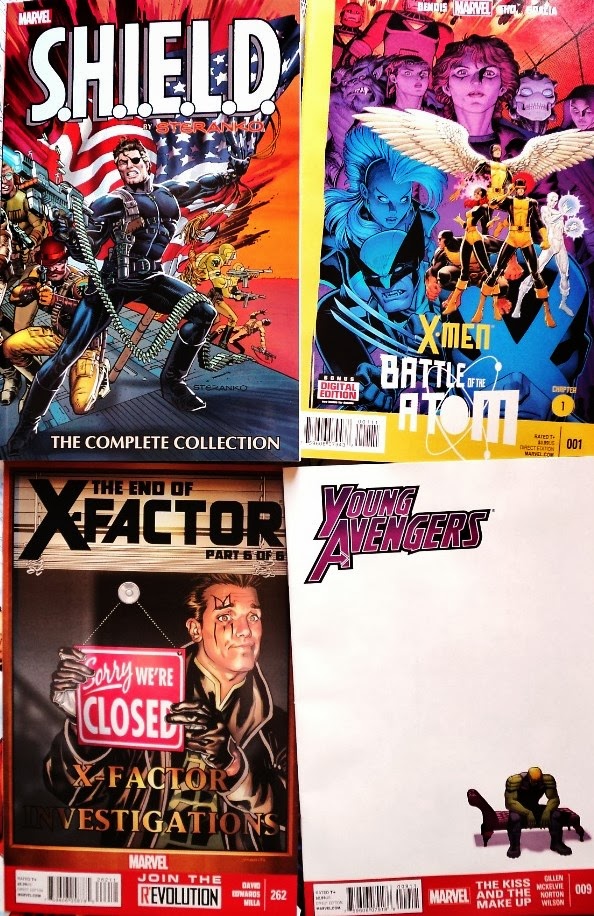
September has been a very good month for me. I’m so excited to read Steranko’s SHIELD and the Best of Milligan and McCarthy (I took a quick look and they look absolutely awesome). I enjoyed X-Men Battle of the Atom and Young Avengers. I was sad to see Peter David’s X-Factor coming to an end, for almost a decade Peter David did his best to turn this title into something extraordinary, and he was successful. X-Factor has been consistently good since the first issues and although many readers think that the level of quality somehow got diminished since 2010 I still think this was one of Marvel’s most solid ongoing titles. Matt Kindt wrote a very exciting first issue with Infinity Hunt, and another great first issue was Avengers, Hickman and Opeña are a great creative team, I wish I had bought this a year ago, when it was originally released. Sidekick and Kick-Ass continue to be top notch, and the Unwritten graphic novel was wonderful. And now, without further ado, here are September comics as per solicitations.

AGE OF ULTRON #9 (OF 10)
(W) Brian Michael Bendis (A/CA) Brandon Peterson, Carlos Pacheco To save the planet Earth - and maybe the entire galaxy! - the heroes of the Marvel Universe made the most controversial decision of their lives. The results have brought disaster the likes of which they have never seen before. And now, with one final chance…can they make it right? 

AVENGERS #1 NOW
(W) Jonathan Hickman & Jerome Opeña (A). 

BEST OF MILLIGAN & MCCARTHY HC (C: 0-1-2) 
(W) Peter Milligan, Brendan McCarthy (A) Brendan McCarthy One of comics' most fruitful collaborations gets its due in this deluxe collection of hard-to-find gems from Peter Milligan (Hellblazer, X-Statix) and Brendan McCarthy (Judge Dredd, The Zaucer of Zilk There is still nothing else like Freakwave, Paradax!, Skin, and Rogan Gosh, and this volume is the ideal starting place for new readers! Collecting twenty years' worth of the pair's finest work from Vanguard Illustrated, Strange Days, 2000 AD, and Vertigo. 

CABLE AND X-FORCE #10
(W) Dennis Hopeless (A/CA) Salvador Larroca Guest starring the Uncanny Avengers! • Hope goes on the run, determined to help Cable whether he wants it or not… …but the Uncanny Avengers have been keeping tabs on Hope and they're not about to let her get tangled up with Cable's band of fugitives! 

IMAGE FIRSTS CHEW CURR PTG #1 (MR)
(W) John Layman (A/CA) Rob Guillory. Tony Chu is a cop with a secret. A weird secret. Tony Chu is Cibopathic, which means he gets psychic impressions from whatever he eats. It also means he's a hell of a detective, as long as he doesn't mind nibbling on the corpse of a murder victim to figure out whodunit, and why. It's a dirty job, and Tony has to eat terrible things in the name of justice. And if that wasn't bad enough, the government has figured out Tony Chu's secret. They have plans for him… whether he likes it or not. 

INFINITY HUNT #1 (OF 4) 
(W) Matt Kindt (A) Steven Sanders (CA) Slava Pasarin INFINITY TIE-IN! • Hank Pym, Wolverine, and She-Hulk bring the students of the Marvel Universe together to announce a new CONTEST OF CHAMPIONS! • This CONTEST OF CHAMPIONS pits the super students of schools all over the Marvel U (including some you've never seen before) against each other. • However, the Contest is interrupted when Thanos' forces descend on Earth. What do they have to do with the young heroes? 

JUDGE DREDD CLASSICS #2 
(W) John Wagner, Alan Grant (A) Ron Smith & Various (CA) Jim Fern. 'Block Mania' continues here! Mega-City One is in the grips of Block Madness, and Dredd must track down the villain who poisoned his city and turned everyone against each other. Close calls and espionage abound in this re-colored collection of Judge Dredd classics. 

KICK-ASS 3 #3 (OF 8) (MR)
(W) Mark Millar (A/CA) John Romita. What's a tween girl assassin to do once she's locked up? Start running all the gangs in the joint, of course! After the surviving the brutal pecking order of middle school, Hit-Girl finds jail just might be a little more up her alley. Meanwhile, Kick-Ass starts learning there's more to life than just superhero work. 

NG EVANGELION SHINJI DETECTIVE DIARY TP VOL 01
(W/A/CA) Takumi Yoshimura When even a tough dude like his school pal Toji is getting menaced by gangsters, a nice guy like Shinji Ikari feels obliged to seek out the local private eye, Ryoji Kaji, and his striking young assistant, Kaworu Nagisa. Somehow, though, Shinji gets drafted into solving the case himself, with Kaworu's help-although Kaworu quickly proves to be a mystery of his own . . . 

SHIELD BY STERANKO TP COMPLETE COLLECTION 
(W) Steranko & Various (A) Steranko, Jack Kirby (CA) Steranko. Rarely before and rarely since has comics seen a talent as innovative as Steranko. Blending together influences from Pop art to Salvador Dali and Will Eisner to Wally Wood, Steranko's boundary-breaking style is an incomparable visual language that continues to influence and inspire storytellers decades later. Now, for the first time ever, Marvel is proud to offer the complete Steranko NICK FURY, AGENT OF S.H.I.E.L.D. in one volume! Collecting NICK FURY, AGENT OF S.H.I.E.L.D. (1968) #1-3 and #5, and material from STRANGE TALES (1951) #151-168. 

SIDEKICK #2 (MR) 
(W) J. Michael Straczynski (A) Tom Mandrake, Brian Miller (CA) Brian Miller, Tom Mandrake. The Moonglow Twins were two of the Red Cowl and Flyboy's greatest enemies.  Now that the Red Cowl is dead, one of them has returned with a vengeance. But whose vengeance, and why, and what is the reason for her sudden interest in Flyboy® Is Flyboy about to find a reason to live and repair his life, or is he about to hurtle down into even greater depths of madness and depravity® It's a monthly book, what the heck do you think is going to happen® The fun is in seeing just how far he spirals downward and what's waiting for him when he hits bottom....  

UNWRITTEN HC TOMMY TAYLOR & THE SHIP THAT SANK TWICE (MR) 
(W) Mike Carey (A) Peter Gross & Various (CA) Yuko Shimizu. This exciting, original graphic novel explores the world of the Tommy Taylor novels in a visceral and direct way and is a great entry point for new readers. Twenty-five years ago Tom's father, Wilson Taylor, devised his subversive literary masterpiece. Now the blueprint of how a father gave his son vast power in order to accomplish a greater scheme is revealed. Partly told through Wilson's own journal entries, juxtaposed with Tommy's swashbuckling deep sea adventures with his trusty companions Peter and Sue, the story is at once a prequel and a parallel story to the ongoing series. 

UNWRITTEN #52 (MR) 
(W) Mike Carey, Bill Willingham (A) Peter Gross, Mark Buckingham (CA) Yuko Shimizu. In 'The Unwritten Fables,' part 3 of 5, Mister Dark finds an ally-someone who hates Tom Taylor more than he ever could, and knows where to hit him so it hurts the most. But as Mister Dark realizes the opportunity he's been offered, the stakes go from high to terrifying for Tom and the Fables refugees.

WALKING DEAD #114 (MR) 
(W) Robert Kirkman (A/CA) Charlie Adlard, Cliff Rathburn. What would Jesus do? 

WOLVERINE #3 NOW 
(W) Paul Cornell (A/CA) Alan Davis • Guest-starring Nick Fury, Agent of S.H.I.E.L.D.! • How will Logan take down a foe with no permanent body to slash and claw? • And what does the Watcher have to do with all of this? 

WOLVERINE AND X-MEN #9 AVX 
Avengers Art Appreciation Variant By Alex Maleev • Avx Tie-In! • Wolverine, Torn Between Two Teams! • Will The Jean Grey School Follow Its Leader? 

X-FACTOR #262 
(W) Peter David (A) Neil Edwards (CA) David Yardin. The end of X-Factor! 

X-MEN BATTLE OF ATOM #1 
(W) Brian Michael Bendis (A) Frank Cho (CA) Arthur Adams • The past, present and future of the X-Men collide in this 50th Anniversary event crossover! When investigating a new mutant, something truly horrible happens to the All-New X-Men that shakes time and space to its core. This is so dire that X-Men come from THE FUTURE with a message: THE ALL-NEW X-MEN MUST RETURN TO THE PAST! • The ten-part crossover starts here with superstars BRIAN MICHAEL BENDIS and FRANK CHO! 

YOUNG AVENGERS #9 NOW 
(W) Kieron Gillen (A/CA) Jamie McKelvie • We wanted to just write 'Screaming! Screaming! Screaming!' for this solicit, but we're told we need boring old facts. :( • Anyway! The Young Avengers road trip across the multiverse goes proper crazy as it reaches it's destination. It's destination is mainly EXCITEMENT and HEARTBREAK. • Several Young Avengers decide what to do next. The question is, whether what they do next is to be Young Avengers... • Honestly, screaming. 
________________________________________________________________________________________________
________________________________________________________________________________________________

Setiembre ha sido un buen mes para mí. Estoy emocionado por leer SHIELD de Steranko y lo mejor de Milligan y McCarthy (dando un simple vistazo puedo decir que se ven estupendos). Disfruté con X-Men Battle of the Atom y Young Avengers. Fue triste ver que X-Factor de Peter David llegara a su fin, por casi una década, Peter David hizo lo posible para convertir este título en algo extraordinario, y tuvo éxito. X-Factor ha sido consistentemente bueno desde los primeros números y aunque muchos fans piensan que el nivel de calidad disminuyó desde el 2010, igual creo que este era uno de los títulos más sólidos de Marvel. Matt Kindt escribió un gran primer número con Infinity Hunt, y otro muy buen primer número fue Avengers, Hickman y Opeña son un grandioso equipo creativo, desearía haber comprado esto hace un año, cuando fue publicado originalmente. Sidekick y Kick-Ass continúan siendo de primer nivel, y la novela gráfica de Unwritten fue maravillosa. Y ahora, sin más preámbulos, aquí están los cómics de setiembre. 

AGE OF ULTRON #9 (OF 10)
Comentario: Para salvar al planeta Tierra –y a la galaxia entera– los héroes tomaron una polémica decisión. Y resultado ha sido desastroso. Y ahora, con una última oportunidad, ¿podrán enmendar las cosas?

AVENGERS #1
Jonathan Hickman & Jerome Opeña.

BEST OF MILLIGAN & MCCARTHY HC (C: 0-1-2)
Lo mejor de Peter Milligan y Brendan McCarthy.

CABLE AND X-FORCE #10
Hope huye, determinada a ayudar a Cable. Pero los Vengadores han estado vigilando a Hope y no permitirán que se enrede con Cable.

IMAGE FIRSTS CHEW CURR PTG #1 (MR)
Tony es un policía con un secreto. Un extraño secreto. Él obtiene impresiones psíquicas de aquello que come. Eso también significa que es un detective endemoniadamente eficaz, siempre y cuando no le moleste mordisquear el cadáver de una víctima de asesinato para averiguar quién es el culpable. Es un sucio trabajo y Tony tendrá que comer las más terribles cosas.

INFINITY HUNT #1 (OF 4)
HANK PYM, WOLVERINE y SHE-HULK reúnen a los estudiantes para anunciar un nuevo torneo de campeones. Pero todo será interrumpido cuando las fuerzas de THANOS lleguen a la Tierra. ¿Qué pasará con estos jóvenes?

JUDGE DREDD CLASSICS #2
Historias clásicas de John Wagner, Alan Grant y Ron Smith.

KICK-ASS 3 #3 (OF 8) (MR)
¿Qué puede hacer una niña asesina en prisión? Liderar a todas las pandillas del lugar, desde luego. Luego de sobrevivir el brutal orden social del colegio, Mindy descubre que la cárcel es algo que sí comprende. 

NG EVANGELION SHINJI DETECTIVE DIARY TP VOL 01
Detectives privados y un caso que debe resolverse.

SHIELD BY STERANKO TP COMPLETE COLLECTION
La clásica etapa de Jim Steranko en SHIELD.
my drawing / mi dibujo

SIDEKICK #2 (MR)
Los gemelos Brillo de Luna fueron dos de los mayores enemigos de RED COWL y FLYBOY. Ahora que RED COWL ha muerto, uno de ellos ha regresado para vengarse. Pero ¿por qué? ¿Y cuál es su interés en FLYBOY? ¿Encontrará FLYBOY un motivo para reparar su vida o está a punto de caer aún más profundamente en la locura y la depravación?

UNWRITTEN HC TOMMY TAYLOR & THE SHIP THAT SANK TWICE (MR)
Hace 25 años, Wilson Taylor, el padre de Tommy, desarrolló su obra maestra de subversión literaria. Ahora se revela cómo el padre confirió poderes a su hijo. Contada desde los viejos diarios de Wilson, y yuxtapuesta al viaje que realiza Tommy con sus amigos, esta novela gráfica traerá sorpresas.

UNWRITTEN #52 (MR)
El Señor Oscuro encuentra un aliado, alguien que odia a Tommy incluso más que él mismo, alguien que sabe cuáles son sus puntos débiles.

WALKING DEAD #114 (MR)
¿Qué haría Jesús?

WOLVERINE #3 NOW
¿Cómo se enfrentará Logan a un enemigo incorpóreo?

WOLVERINE AND X-MEN #9 AVX
¿Seguirá la escuela a WOLVERINE, su líder?

X-FACTOR #262
¡El fin de X-Factor!

X-MEN BATTLE OF ATOM #1
El pasado, presente y futuro de los X-MEN está aquí. Al investigar a un nuevo mutante, algo terrible sucede, algo que alterará el tiempo. 

YOUNG AVENGERS #9 
Solamente queríamos escribir ¡Gritos, gritos, gritos! pero nos dicen que mejor es poner algunos hechos. En fin, el viaje de los Jóvenes Vengadores por el universo se vuelve una locura cuando llegan a su destino. Su destino es sobre todo excitación y desconsuelo. Ahora deberán decidir qué hacer. ¡Gritos!

October 13, 2013

Heartburst - Rick Veitch

Xenophobia and racism are often two expressions of the same fundamental human flaw: fear. Fear can take many forms, it can lead us to intolerance, bury our common sense and make us hate the unknown and disavow it before we even get a chance to know it. It’s true, we abhor that which we do not understand. 

It would be easy to find examples of xenophobia and racism in recent centuries. But Rick Veitch’s Heartburst is not confined to Earth. It takes place, in fact, in a faraway galaxy, in a world that has been invaded by earthmen. Humans have enslaved the Ploo, a peaceful race of humanoids that had always lived in this strange planet. And because these aliens represent the unknown, we fear them and hate them intensely and irrationally. 

Trying to preserve their “genetic purity”, humans have forbidden interracial relationships. Sex between a human and a Ploo is strictly prohibited. And anyone who disobeys that order can be sentenced to death. One day the inquisitor and his young nephew Sunoco Firestone visit a female prisoner that claims to come from Earth. Nobody believes her, after all, even at light speed a journey like that would take centuries. In fact, only now, the humans are receiving TV transmissions emitted 300 years ago; in their ignorance, they take these transmissions –old TV shows and advertising– as the indisputable word of the Lord. 

But Sunoco, somehow, knows that this religion makes no sense. And one night, while he is in the circus with his best friend, he falls in love with a native Ploo. As a hotheaded young man, he can’t resist the urge to have sex with this alien. And so they copulate. Sunoco, now a heathen and an outlaw, must leave everything behind and venture into the wild and unexplored regions of the planet. 
Sunoco Firestone's first sexual experience /
la primera experiencia sexual de Sunoco Firestone

As the years go by, Sunoco and her lover part ways. She’s pregnant and he fears the offspring of such union will be a monstrosity. Sunoco gets older, and he is a witness a savage war. Humans are annihilating what was once a proud and peaceful civilization. Rick Veitch writes a very compelling story about racism, intolerance and fear, and I must highlight his mature approach, which surprised me a lot, especially considering that this was first published in 1978, an era ruled by censorship and conventionalism. 

Veitch illustrated Heartburst using the most advanced techniques of the 70s, his mastery over the airbrush can be compared with the works of the legendary artist Richard Corben. But there is more, there is an admirable level of detail, and above all, a true love for color. This is one of the most amazing coloring works of the 70s and 80s; combining as many technical resources as possible, Rick Veitch creates page after page of stunning art. Pencils, inks and colors integrate harmonically in one exquisite and unforgettable visual feast.  

Heartburst and Other Pleasures reprints the 70s classic, and it also includes some rare short stories written or illustrated by Veitch, such as “Sneaky Pete” (Bedlam Comics), “Underpass” (Streetwise) and the magnificent “A Day To Remember” (Bananas Magazine, 1982), a crazy sci-fi tale written by Bob (R L) Stine  that reminded me of the best Tharg’s Future Shocks from 2000AD. Four pages of great writing and even greater art. 

Nevertheless, there is another hidden gem here: “The Mirror of Love”, written by Alan Moore and illustrated by Stephen R. Bissette and Rick Veitch. It was originally published in 1988 in AARGH! (Artists Against Rampant Government Homophobia) as a response to Margaret Thatcher’s attempts to “eradicate” homosexuality in England. Instead of a traditional story, Moore creates a sort of ‘sequential documentary’, highlighting the most important moments of gay culture throughout thousands of years. As Veitch explains “It’s a gorgeous example of the rhythmic style he’d evolved in his commercial comics, taken to achingly lyrical heights”. There are two narrative levels developed simultaneously, the first depicts historical facts and is drawn by Stephen R. Bissette with rich inks and a painted-like texture; the second level focuses on two male angels, lovers that share their joy or suffering depending on what happens in any given century. 
War victims / víctimas de la guerra

Alan Moore begins with animals, specifically mammals, showing us how common homosexual encounters are in nature; then he moves onto the Paleolithic era and the first human cultures. In a brilliant and concise way, Moore emphasizes the arbitrariness of the Bible (in the Leviticus if a man eats pork he has committed a grave sin, and if a man has sex with another man he has also committed a grave sin) and the real political reasons behind the disapproval of certain sexual practices. Then he goes to Ancient Greece and the Roman Empire, both cultural oases in the deserts of intolerance. He talks about Sapho and the love between women that gave notoriety to the island of Lesbos. And he reminds us of how the Christian church turned into a discriminatory institution. After medieval hate, love is finally resurrected in the Renaissance, if only briefly. 

Then comes Elizabethan England and the Victorian age, in which homosexuality is not only considered a sin but also a disease. Something that can be explained by science and also cured. We see the trial of Oscar Wilde, accused of sodomy by the Marquis of Queensbury. And then Moore takes us to clandestine sexual encounters in public bathrooms and to the unexpected –and well documented– cases of love between men in the trenches of WWI. And then comes Hitler, who not only exterminated Jews but also homosexuals, forcing them to wear a pink triangle in concentration camps. And then comes the 60s and the 70s, with their queer writers, singers and artists. And AIDS, which affects all mankind but was originally labeled as the “gay plague”. 

Moore describes some really heartbreaking moments: “In slaughter houses, labeled with pink triangles, our thousands died […] bodies piled up as if the strong and desperate had climbed on lover’s backs to flee […] betraying at last our love, the thing we thought they couldn’t take. Can you imagine? Can you?”. I’ve seen dozens of movies about the holocaust, and I always take them with the objectivity of a historian. This time, however, with only one panel, Moore has moved me in ways I find hard to process. 

There is strength and poetry in the way Moore talks about gay people fighting for their rights during the Stonewall riots. “The Mirror of Love” made me feel sadness, anger and hope. In many ways, this has been like staring myself at the mirror, and finding something that had always been there, in plain view, and that I hadn’t noticed before. 

It is important to defy laws and traditions when they are unfair. “I’ll be refused a heaven crammed with popes, policemen, fundamentalists, and burn happy instead, quite happily, with Sappho, Michelangelo and you, my love”. Indeed, and authors like Alan Moore shall forever be keepers of the flame.
________________________________________________________________________________________________
________________________________________________________________________________________________


Sunoco's last hope / la última esperanza de Sunoco
La xenofobia y el racismo son a menudo dos expresiones de un mismo y fundamental defecto humano: el miedo. El miedo puede tomar muchas formas, nos puede llevar a la intolerancia, a enterrar nuestro sentido común y a odiar lo desconocido y desaprobarlo antes de tener una oportunidad de conocerlo. Es cierto, aborrecemos aquello que no entendemos.

Sería fácil encontrar ejemplos de xenofobia y racismo en siglos recientes. Pero “Heartburst” de Rick Veitch no está confinado a la Tierra. De hecho, sucede en una galaxia lejana, en un mundo que ha sido invadido por los terrícolas. Los humanos han esclavizado a los Ploo, una pacífica raza de humanoides que ha vivido en ese planeta desde siempre. Y como estos alienígenas representan lo desconocido, los tememos y odiamos intensa e irracionalmente.

Intentando preservar su “pureza genética”, los humanos han vedado las relaciones interraciales. El sexo entre un humano y un Ploo está estrictamente prohibido. Y cualquiera que desobedezca esa orden será sentenciado a muerte. Un día el  inquisidor y su joven sobrino Sunoco Firestone visitan a una prisionera que clama haber venido de la Tierra. Nadie le cree, después de todo, incluso a la velocidad de la luz un viaje así tomaría siglos. De hecho, recién ahora, los humanos están recibiendo transmisiones de televisión emitidas hace 300 años; y en su ignorancia, asumen que estas transmisiones –viejos programas de televisión y propagandas– son la palabra indisputable del todopoderoso.

Pero Sunoco, de algún modo, sabe que esta religión no tiene sentido. Y una noche, mientras está en el circo con su mejor amigo, se enamora de una nativa Ploo. Al ser un jovencito calenturiento, no puede resistir la urgencia de tener sexo con esta alienígena. Así que copulan. Sunoco, ahora un hereje y un fuera de la ley, debe dejar todo atrás y aventurarse en las regiones salvajes e inexploradas del planeta. 

Cuando pasan los años, Sunoco y su amada optan por caminos divergentes. Ella está embarazada y él teme que el fruto de semejante unión sea una monstruosidad. Sunoco envejece y es testigo de una salvaje guerra. Los humanos están aniquilando lo que alguna vez fue una orgullosa y pacífica civilización. Rick Veitch escribe una cautivante historia sobre el racismo, la intolerancia y el miedo; y debo resaltar su enfoque maduro, que me sorprendió mucho, especialmente teniendo en cuenta que esto fue publicado por primera vez en 1978, una época dominada por la censura y el convencionalismo. 
The Mirror of Love / El espejo del amor

Veitch ilustró Heartburst usando las técnicas más avanzadas de los 70, su dominio del aerógrafo puede compararse a los trabajos del legendario artista Richard Corben. Pero hay más, hay un admirable nivel de detalle y, por encima de todo, un auténtico amor por el color. Este es uno de los más asombrosos trabajos de coloreado de los 70 y 80; combinando todos los recursos técnicos posibles, Rick Veitch crea página tras página de espectacular arte. Lápices, tintas y colores se integran armónicamente en un exquisito e inolvidable festín visual.

“Heartburst and Other Pleasures” reimprime el clásico de los 70, y también incluye algunas historias cortas escritas o ilustradas por Veitch, como “Sneaky Pete” (Bedlam Comics), “Underpass” (Streetwise) y el magnífico “A Day To Remember” (Bananas Magazine, 1982), un alocado relato de ciencia ficción escrito por Bob (R L) Stine que me recordó a los mejores “Future Shocks” de Tharg en “2000AD”. Cuatro páginas de buen guión y estupendo arte.

No obstante, hay otra joya oculta aquí: “El espejo del amor”, escrito por Alan Moore e ilustrado por Stephen R. Bissette y Rick Veitch. Publicado originalmente en 1988, en AARGH! (Artistas Contra la Homofobia Descontrolada del Gobierno, en inglés) como una respuesta a los intentos de Margaret Thatcher de "erradicar" la homosexualidad en Inglaterra. En vez de una historia tradicional, Moore crea una suerte de ‘documental secuencial’, resaltando los momentos más importantes de la cultura gay a lo largo de miles de años. Como explica Veitch “Es un hermoso ejemplo del estilo rítmico que él había desarrollado en sus cómics comerciales, llevado a alturas de doliente lirismo”. Hay dos niveles narrativos que son ejecutados simultáneamente, el primero retrata hechos históricos y es dibujado por Stephen R. Bissette con ricas tintas y una textura como de pintura; el segundo nivel se enfoca en dos ángeles masculinos, amantes que comparten el goce o el sufrimiento dependiendo de lo que pasa en cada siglo.

Alan Moore empieza con animales, específicamente mamíferos, mostrándonos cómo los encuentros homosexuales son comunes en la naturaleza; luego pasa a la era paleolítica y a las primeras culturas humanas. De manera brillante y concisa, Moore enfatiza la arbitrariedad de la Biblia (en el Leviticus si un hombre come carne de cerdo ha cometido un pecado grave, y si un hombre tiene sexo con otro hombre también ha cometido un pecado grave) y las verdaderas razones políticas detrás de la desaprobación de ciertas prácticas sexuales. Luego se dirige a la Antigua Grecia y al Imperio Romano, ambos oasis culturales en los desiertos de la intolerancia. Habla sobre Safo y el amor entre mujeres que dio notoriedad a la isla de Lesbos. Y nos recuerda cómo la iglesia cristiana se convirtió en una institución discriminadora. Después del odio medieval, el amor finalmente resucita en el Renacimiento, aunque brevemente.
Stephen R. Bissette & Rick Veitch

Luego llega la Inglaterra isabelina y la era victoriana, en la que la homosexualidad no sólo era considerada un pecado sino también una enfermedad. Algo que podía ser explicado por la ciencia y también curado. Vemos el juicio de Oscar Wilde, acusado de sodomía por el Marqués de Queensbury. Y luego Moore nos lleva a los encuentros sexuales clandestinos en baños públicos y a los inesperados –y bien documentados– casos de amor entre hombres en las trincheras de la Primera Guerra Mundial. Y luego llega Hitler, que no sólo exterminó a los judíos sino también a los homosexuales, obligándolos a llevar un triángulo rosado en los campos de concentración. Y luego llegan los 60 y los 70, con sus escritores, cantantes y artistas gays. Y el SIDA, que afecta a toda la humanidad pero que originalmente fue llamado la “plaga gay”. 

Moore describe algunos momentos que nos rompen el corazón: “En mataderos, etiquetados con triángulos rosados, morimos por miles […] cuerpos apilados como si el fuerte y el desesperado hubiese trepado sobre la espalda del amado para escapar […] traicionando por fin nuestro amor, aquello que pensamos que no nos podrían quitar. ¿Podéis imaginarlo? ¿Podéis”. He visto docenas de películas sobre el holocausto, y siempre las recibo con la objetividad de un historiador. Esta vez, sin embargo, con una sola viñeta, Moore me ha conmovido de una manera que me resulta difícil de procesar. 

Hay fuerza y poesía en la manera en la que Moore habla sobre los gays que luchan por sus derechos durante los disturbios de Stonewall. “El espejo del amor” me hizo sentir tristeza, rabia y esperanza. En cierto modo, ha sido como mirarme a mí mismo en el espejo, y encontrar algo que siempre había estado allí, a simple vista, y que no había notado antes.  

Es importante desafiar las leyes y tradiciones cuando son injustas. “Me será rehusado ese cielo infestado con papas, policías, fundamentalistas, y en su lugar arderé feliz, bastante felizmente, con Safo, Miguel Ángel y contigo, mi amor”. En efecto, y autores como Alan Moore serán eternamente los guardianes del fuego.

October 12, 2013

Rabioso: Director’s Cut - Alejandro Hernández


In 2010 I was lucky enough to participate in the historical first issue of “The Gathering”. I wrote a two page story. I was in charge of penciling, inking and lettering it. I did it all. I can’t say I’m completely satisfied with the result, it looks a bit substandard now, but at the moment it was the best I could do with the tight deadlines and all that.

Alejandro Hernández

As you can see, this is my handwriting, and that also includes the title design (“Stains Over Dirty Snow”). I used a lot of shadows and black areas to avoid backgrounds; that was by far the easiest solution at the moment. I couldn’t get the face of the nurse right so I covered that with a caption. I don’t know why, but it took me a couple of years to learn to draw women and even to this day I still feel my women don’t look as good as they should.


I still managed to include my usual signature, an A mixed with a C, something that is present in every single page I’ve drawn in the past 3 or 4 years. It’s a little detail, always hidden somewhere, but always easy to identify. This little symbol has been inspired by John Cassaday’s signature (in his case a J with a C), and I always have fun trying to hide it in some of my panels. So far, no one has ever discovered where I place my signatures, and that means that most readers don’t pay enough attention or don’t have a good memory. Either way, in this and future pages of my work I’ll let reveal this and other little mysteries. Enjoy!


________________________________________________________________________________________________

________________________________________________________________________________________________
my drawing / mi dibujo

Ayer jueves se inauguró “Rabioso: Director’s Cut” de Alejandro Hernández (Paranga) en la sala de Dédalo. Debo admitir que en realidad no conocía al artista, pero fue Hugo Alegre quien me animó a darme una vuelta por este espacio barranquino que tanto significa para mí y al que tantas veces he visitado en los últimos diez años.

Llegué y quedé admirado por la coherencia de la propuesta y por los cuadros extraordinarios que nos remiten no sólo a artistas peruanos como Tola sino a muchos otros de talla internacional. Entre mis obras favoritas está la secuencia de cuadros que muestra la transformación de un ‘paciente cero’, en un inicio es el propio artista quien se retrata de manera ‘normal’ y luego va mutando en los cuadros siguientes hasta convertirse en un monstruo similar al que veríamos en una película de terror. Como comentaba con Pedro Casusol, esta ha sido una de las mejores muestras que hemos visto en Dédalo en los últimos meses.


Además de conversar con Hugo y Carmen Alegre, también saludé a María Elena Fernández, Eduardo Lores, Gabriel Lores, Sebastián Lores y Mariana Lores. Me quedé conversando con Isabelle Decencière  y Mónica Cuba, quienes presentarán una muestra también en Dédalo el año que viene. También me encontré con Renzo Farje, amigo de la facultad de literatura de la PUCP, y conocí a Jorge Vargas Prado, ambos habían hecho una escala en Dédalo de camino a un recital de poesía. Aunque quise acompañarlos, pudo más mi pasión por los riquísimos chilcanos de pisco Larroca. Pero no me quedé solo, porque al rato llegó Hugo Salazar y nos quedamos hablando hasta pasadas las diez de la noche. 


Este viernes el punto de encuentro fue en el Centro Colich. Se inauguró la muestra Hanan Pacha de Mili DC Hartinger. Los paisajes adquieren un enorme valor estético gracias a la mirada extraordinaria de quien está detrás de la cámara. En el transcurso de la noche conversé sobre todo con José Medina, y me encontró con muchos otros amigos. 


October 8, 2013

Neon Genesis Evangelion Vol. 10 - Yoshiyuki Sadamoto

Kaworu Nagisa, the fifth child / Kaworu Nagisa, el quinto niño
Last week I took a long walk that led me to an old and familiar stadium. I used to go there twice a week when I was in high school. As I passed by the stadium, I noticed a group of boys training for some undecipherable sport… I stood there. And I watched them. They were fooling around, some were trying to push their classmates, others would play with their gym shorts, pulling them up and making them look like pulpy underwear, others would pinch the leg of another kid and so on. During an interval of 10 minutes I was taken aback. I too had seen the same sort of childish games taking place amongst my peers, over a decade ago. This was nothing special, nothing worthy of my time. And yet I stood there; protected, as I was, by the iron fences. 

And then it hit me. That’s what being a teen is all about. Doing foolish things, touching other people’s skin as if we were trying to get a hold of the essence of the world. And, at the same time, there was something else in the way these teenagers acted. I remembered my years in high school and I remembered how often I thought there was something sexual in those games, a repressed homoeroticism that would burst when one of my friends –and this happened very often– would pull down another boy’s shorts in jest. Yes, it might all seem like a juvenile prank, but it might also be a manifestation of a burgeoning sexuality. In the end, as I slowly resumed my walk, still glimpsing sideways at these youngsters, I had another epiphany. I could never be sure of the meaning of those games, did they do those things for laughs or was it actually a sign of sexual curiosity? I didn’t know; and, had I asked them, neither would they. And that’s the beauty of adolescence: its wonderful ambiguity, its elated state of confusion and uncertainty.   
Shinji Ikari & Kaworu Nagisa

It is precisely that ambiguity which makes the relationship between Shinji Ikari and Kaworu Nagisa one of the most fascinating aspects of Neon Genesis Evangelion. Because we don’t know what’s going on in their minds. We can’t be sure if there is something sexual going on, if they’re simply experimenting, adapting to their bodily changes or if there’s something else, far beyond the hormonal turmoil of their teen years. 

After the catastrophic battle with the angel Armisael and the complete annihilation of Unit-00, Shinji is devastated: Rei Ayanami had to sacrifice herself in order to destroy the angel. Shinji mourns the loss and braces for the emotional impact: “It hits… and I’m alone, and it keeps hitting me down until it crushes me”. Since Kaworu had no ties with Rei, Shinji feels unexpectedly comfortable with him. In fact, the two youngsters spend three days together. But a lot can happen in three days, especially if these two teenagers share the bed.

There is a particular moment that took my breath away –much in the same way that Shinji suffocates at night–while they’re sleeping together. Let’s face it, who hasn’t shared his bed with a friend, specifically at that age? In most cases, it leads to nothing. In some cases, however, certain nocturnal “rubs” can occur. Shinji is so agitated after Rei’s demise, that he has problems breathing. Kaworu then grabs him gently, and lips are pressed against lips. Is it a voluptuous kiss? Is Kaworu an erotic provocateur? Or is he simply administrating the oxygen Shinji requires? Again, like I postulated earlier, is there a truly homosexual motivation behind the kid’s acts or is this matter purely experimental? After a long kiss, Shinji snaps out of it and pushes Kaworu away.  
A moment of intimacy / un momento de intimidad

As the fifth child, as the angel Tabris, Kaworu has no knowledge of human emotions, apart from a theoretical approach. And yet, here he is, taking a risk with Shinji, wondering what the nature of love is. He asks Shinji how it feels to be in love. Do we define love by our need to touch the other? Or kiss them? Or feeling that they are irreplaceable for us? Kaworu might be an angel, with enough power to destroy Earth, but he’s come to our world in the body of a 14 year-old boy, and now he has all these urges and emotions and feelings that he can neither control nor fully understand. When Kaworu is about to touch Shinji again, the phone rings. Shinji answers nervously, almost as if he had been “saved by the bell”, and he finds out something completely unexpected: Rei Ayanami is back. 

Shinji is very excited to hear that Rei isn’t dead, but when he meets the girl he realizes she isn’t the Rei he knew. She’s a clone. Shinji Ikari, Ritsuko Akagi and Misato Katsuragi will uncover one of NERV’s most sinister secrets. What is Rei’s relationship with Shinji’s mother? And why in one of the deepest subbasements of NERV there are hundreds of cloned bodies of Rei Ayanami? 

In the epilogue of volume 10 (which comprises stages 64 through 70: “Tears”, “I Want To Become One”, “Without Reaching Your Heart”, “Twisted Night”, “Mixing”, “Tainted Blood” and “A Gathering of Nothingness”) Sadamoto affirms “I’ve thought at great length about how nice it is to be young. Especially when it comes to love […] I am writing this and reliving my youth, even if only emotionally”. I am writing this too. And I’m, indeed, reliving my adolescence. Because like Kaworu I also had all these urges and emotions and feelings that made no sense to me back then. But unlike Kaworu, I never had the courage to explore them. I guess, in a way, I was just as scared as Shinji when he rejects the kindly touch of a true friend.

________________________________________________________________________________________________
________________________________________________________________________________________________
The risks of sharing a bed... / los riesgos de compartir la cama...

La semana pasada salí a caminar y terminé en un viejo y conocido estadio. Solía ir allí dos veces por semana cuando estaba en secundaria. Mientras pasaba por el estadio, noté a un grupo de chicos entrenándose para algún indescifrable deporte... Me quedé allí. Y los miré. Estaban haciendo tonterías, algunos intentaban empujar a sus compañeros, otros jugaban con sus shorts, jalándolos hacia arriba y haciendo que se vean como ropa interior, otros pellizcaban la pierna de algún muchacho, etc. Durante un intervalo de 10 minutos sentí que estaba en el ayer. Yo también había visto el mismo tipo de juegos infantiles entre mis coetáneos, hace más de una década. Esto no era nada especial, nada que valiese la pena ver. Y sin embargo me quedé allí; protegido por las rejas de fierro.

Y entonces lo supe. En eso consiste ser un adolescente. En hacer tonterías, en tocar la piel de los demás como si se intentara agarrar la esencia del mundo. Y, al mismo tiempo, había algo más en la manera en que estos chiquillos actuaban. Recordé mis años en secundaria y recordé qué tan a menudo pensaba que había algo sexual en esos juegos, un homoerotismo reprimido que estallaba cuando uno de mis amigos –y esto pasaba con frecuencia– le bajaba los shorts a algún chico en broma. Sí, todo podría parecer una jugarreta juvenil, pero también podría ser la manifestación de una sexualidad en ebullición. Al final, mientras retomaba lentamente mi caminata, dando un vistazo de reojo a estos jovencitos, tuve otra epifanía. Nunca podría estar seguro del significado de esos juegos, ¿ellos hacían estas cosas para reírse o todo  era, de hecho, una señal de curiosidad sexual? No lo sabía; y, si acaso se los hubiese preguntado, ellos tampoco lo sabrían. Y esa es la belleza de la adolescencia: su maravillosa ambigüedad, su jubiloso estado de confusión e incertidumbre.

Es precisamente esa ambigüedad lo que hace que la relación entre Shinji Ikari y Kaworu Nagisa sea tan fascinante. Porque no sabemos qué es lo que ocurre en sus mentes. No podemos asegurar que hay algo sexual allí, si ellos simplemente están experimentando, adaptándose a los cambios corporales o si hay algo diferente, que va más allá del terremoto hormonal propio de esa edad.
Shinji is afraid of being kissed / Shinji tiene miedo de ser besado 

Después de la catastrófica batalla con el ángel Armisael y la completa aniquilación de la Unidad-00, Shinji está devastado: Rei Ayanami tuvo que sacrificarse para destruir al ángel. Shinji llora la pérdida y se prepara para el impacto emocional: “Me golpea... y estoy solo, y me sigue golpeando hasta que me derrumba”. Como Kaworu no tenía ningún vínculo con Rei, Shinji se siente inesperadamente cómodo con él. De hecho, los muchachos pasan tres días juntos. Pero en tres días puede pasar mucho, especialmente si estos adolescentes comparten la cama.

Hay un momento en particular que me dejó sin aliento –del mismo modo que Shinji se sofoca en la noche– mientras están durmiendo juntos. Admitámoslo, ¿quién no ha compartido su cama con un amigo, específicamente a esa edad? En la mayoría de los casos, nada sucede. En algunos casos, sin embargo, ciertos "roces" nocturnos pueden ocurrir. Shinji está tan agitado después del fallecimiento de Rei que tiene problemas para respirar. Kaworu entonces lo sujeta tiernamente, y labios son presionados contra labios. ¿Es este un beso voluptuoso? ¿Es Kaworu un provocador  erótico? ¿O simplemente está administrando el oxígeno que Shinji requiere? Nuevamente, como postulé antes, ¿hay una motivación verdaderamente homosexual detrás de los actos de este chico o es este un asunto puramente experimental? Después de un largo beso, Shinji reacciona y empuja a Kaworu.

Como el quinto niño, como el ángel Tabris, Kaworu no tiene conocimiento de las emociones humanas, más allá de un acercamiento teórico. Y no obstante, se arriesga con Shinji, preguntándose cuál es la naturaleza del amor. Él le pregunta a Shinji qué se siente al estar enamorado. ¿Definimos el amor por nuestra necesidad de tocar al otro? ¿O besarlo? ¿O sentir que el otro es irreemplazable? Kaworu puede ser un ángel, con suficiente poder para destruir la Tierra, pero ha venido a nuestro mundo en el cuerpo de un chico de 14 años, y ahora tiene todos estos deseos y emociones y sentimientos que no puede controlar ni comprender. Cuando Kaworu está a punto de tocar a Shinji de nuevo, el teléfono suena. Shinji responde nerviosamente, casi como si hubiese sido “salvado por la campana”, y se entera de algo completamente inesperado: Rei Ayanami ha vuelto. 

Shinji está emocionado al escuchar que Rei no murió, pero cuando se encuentra con la chica se da cuenta de que ella no es la Rei que él conoció. Ella es un clon. Shinji Ikari, Ritsuko Akagi y Misato Katsuragi descubrirán uno de los más siniestros secretos de NERV. ¿Cuál es la relación entre Rei y la madre de Shinji? ¿Y por qué en uno de los sub-sótanos más profundos de NERV hay cientos de cuerpos clonados de Rei Ayanami? 
Rei has been cloned hundreds of times / Rei ha sido clonada cientos de veces

En el epilogo del volumen 10 (que incluye las etapas 64 a 70: “Lágrimas”, “Quiero convertirme en uno”, “Sin alcanzar tu corazón”, “Noche retorcida”, “Mezclando”, “Sangre manchada” y “Reuniendo la nada”) Sadamoto afirma “He pensado largo y tendido sobre lo bonito que es ser joven. Especialmente cuando se trata del amor […] Estoy escribiendo esto y reviviendo mi juventud, aunque sea emocionalmente”. Yo también estoy escribiendo esto. Y estoy, de hecho, reviviendo mi adolescencia. Porque al igual que Kaworu yo también sentí todos esos deseos y emociones y sentimientos que parecían no tener sentido en ese entonces. Pero a diferencia de Kaworu, nunca tuve la valentía de explorarlos. Supongo que, de algún modo, estaba tan asustado como Shinji cuando rechaza el contacto cariñoso de un amigo de verdad.

October 4, 2013

KICK-ASS 2 - Mark Millar & Romita Jr.

If Kick-Ass has his superhero team, then the Mother Fucker must have his own super-villain group: the Mega Toxic Cunts! Perhaps the most notable member is Mother Russia, a dangerous and very lethal woman. Together, they attack the secret base of Justice Forever, and they kill Colonel Stripes and smash the whole place.

Of course, the Mother Fucker doesn’t stop there. His next incursion is a wild explosion of violence. He shoots children in the streets of a peaceful suburb and orders his men to indiscriminately kill as many people as they can, with one goal in mind: breaking and entering into Katie Deuxma’s house. There, he rapes her and asks his men to rape her as well. Having a girl getting ‘gang banged’ was certainly controversial; and surely many readers complained about the level of viciousness. But I consider it a necessary development. Because that’s how we can attest, without a shadow of a doubt, that the Mother Fucker is the coldest and nastiest adversary ever (in the movie “Kick-Ass 2”, the rape scene is replaced by a clever solution. Obviously, unless you are Michael Haneke or Lars Von Trier you can’t get away with something like that, and even if you do, the distributors and the audience might feel uncomfortable).

However, there is an increase in hostilities. The Mother Fucker has raped Katie because he knows that by doing that he’s hurting Kick-Ass. As Machiavellian as it sounds, he intends to slaughter first the people Dave loves the most and then to kill Dave. After the massacre in the suburbs, the chief of police decides to arrest every person wearing a mask or a cape, and thus just as quickly as it begun, Justice (not so) Forever gets disbanded. When the police officers arrive to Lizewski’s address, Dave’s father decides to give a false confession, and thus the officers believe they’re arresting the real Kick-Ass.

Dave Lizewski feels awfully guilty about this, but nothing prepares him for what comes next. Following the Mother Fucker’s orders, two criminals kill Dave’s father in jail. This was definitely one of the most shocking moments of the series, and it’s hard for me to forget how I felt when I first read it. Millar did such an amazing work with Kick-Ass that every character mattered. As a reader, you always felt that they were important, special, in a strange way almost as irreplaceable as real people. That’s one of the highest accomplishments of any work of literature: to make us care about fictional people as much as we care for the men or women sitting next to us.

In the funeral, Mindy –AKA Hit-Girl– finally appears. She has been absent for months, rebuilding her life, trying to have the one thing she could never experience before: a normal childhood. But things are not meant to be nice and easy for Hit-Girl (after all, in the final pages of this volume she’ll be arrested, something that is omitted in the Kick-Ass movie sequel).  

And then comes the savage confrontation: Mother Fucker versus Kick-Ass, Mother Russia versus Hit-Girl, and the Toxic Mega Cunts versus Justice Forever. Millar has always exceled in the game of violence, he knows just how much blood to pour, how many dismemberments to show and what gruesome deaths are the most spectacular ones. Other writers might try to be violent, but without any substance to support that violence the narrative becomes a hollow artifice. Fortunately, Millar never forgets the story, and he finds the most astounding ways to combine violent sequences with dramatic moments.

The battle in Times Square is impressive, but of course nothing can be compared to the titanic clash between Hit-Girl and Mother Russia. Nevertheless, Millar reminds us that real violence has real consequences. Dave Lizewski learnt that in the first issue, when he spent months in a hospital recovering from his injuries. Now, when Kick-Ass fights against the Mother Fucker, something unexpected happens. After getting punched in the face, the villain falls off a building. This is a very singular moment and one that expresses the originality of this series. There is hate in the fists of Kick-Ass, after all, his nemesis has raped the girl he adores and murdered his father. He has genuine reasons for wanting to kill the guy responsible for all this. And yet, when he accidentally pushes the Mother Fucker off the building, he feels sick.
Dave's father dies in jail / el padre de Dave muere in prisión

And after the brutal fall, in a moment of weird tenderness, Chris Genovese, the boy formerly known as Red Mist, asks Dave for help. He has survived the fall, his arms and legs are broken, he’s bleeding profusely, he looks like he will only survive for a few minutes. And he asks Dave for help, he begs Dave to call an ambulance. And how can Dave say no to him? He immediately reaches for his cell phone and dials 911. There is a strange relationship between the hero and the villain, they were the best of friends when they first met, they always shared their passion for comic books even when they chose different paths in life, and now, when they have hurt each other beyond measure, when they have reached that point of agony that goes beyond all forms of pain, they still help each other. Chris promises not to accuse Dave of trying to kill him, and Dave promises him that he’ll survive. I really don’t know how to explain the significance of this moment. Because, against all odds, they both keep their promises. And together they forge an inexorable link, something as irrational as the passion we comic book lovers feel for this art. 
Toxic Mega Cunts / Bastardos Mega Tóxicos 

________________________________________________________________________________________________
________________________________________________________________________________________________
Hit-Girl versus Mother Russia

Si Kick-Ass tiene un equipo de superhéroes, entonces Mother Fucker debe tener su propio grupo de súper-villanos: ¡los Bastardos Mega Tóxicos! Tal vez la integrante más notable es Mother Russia, una mujer peligrosa y letal. Juntos, atacan la base secreta de Justicia Eterna, y matan a Colonel Stripes y destrozan todo el lugar.

Por supuesto, Mother Fucker no se detiene allí. Su próxima incursión es una explosión salvaje de violencia. Le dispara a niños en las calles de un pacífico suburbio y ordena a sus hombres que maten indiscriminadamente a toda la gente que puedan, con una sola meta: irrumpir en el hogar de Katie Deuxma. Allí, la viola y le pide a sus hombres que también la violen. Esta 'violación en masa' ciertamente fue controversial; y seguramente muchos lectores se quejaron por el nivel de bestialidad. Pero considero que era un desarrollo necesario. Porque de ese modo podemos comprobar, sin duda alguna, que Mother Fucker es un adversario cruel y vengativo (en la película “Kick-Ass 2”, la escena de la violación es reemplazada con una ingeniosa solución. Obviamente, a menos que seas Michael Haneke o Lars Von Trier no puedes salirte con la tuya, e incluso si lo logras, los distribuidores y la audiencia podrían sentirse incómodos).
Dave Lizewski & Chris Genovese

Sin embargo, hay un incremento en las hostilidades. Mother Fucker ha violado a  Katie porque sabe que al hacerlo le está haciendo daño a Kick-Ass. Por maquiavélico que suene, él intenta matar primero a las personas que más quiere Dave y luego matar a Dave. Después de la masacre en los suburbios, el jefe de la policía decide arrestar a todas las personas que lleven una máscara o una capa, y así tan rápido como empezó, Justician (no tan) Eterna es desarticulada. Cuando los policías llegan a la dirección de Lizewski, el padre de Dave decide dar una falsa confesión, y así los oficiales creen que están arrestando al verdadero Kick-Ass.

Dave Lizewski se siente terriblemente culpable, pero nada lo prepara para lo que pasa después. Siguiendo las órdenes de Mother Fucker, dos criminales matan al padre de Dave en la cárcel. Definitivamente este fue uno de los momentos que más me impactó, y es difícil olvidar lo que sentí. Millar hizo un trabajo asombroso con Kick-Ass, todos estos personajes tenían valor. Como lector, uno sentía que eran importantes, especiales, y de alguna extraña manera, casi tan irreemplazables como personas reales. Ese es uno de los mayores logros de una obra de literatura: hacernos querer a gente ficticia tanto como queremos a los hombres o mujeres que se sientan a nuestro alrededor.

En el funeral, Mindy –Hit-Girl– finalmente aparece. Ella había estado ausente por meses, reconstruyendo su vida, intentando tener lo que nunca había experimentado antes: una niñez normal. Pero las cosas no serán agradables ni fáciles para Hit-Girl (después de todo, en las páginas finales de este volumen será arrestada, algo que es omitido en la secuela fílmica de Kick-Ass).  
Hit-Girl is finally captured / Hit-Girl finalmente es capturada

Y luego viene la brutal confrontación: Mother Fucker versus Kick-Ass, Mother Russia versus Hit-Girl, y los Bastardos Mega Tóxicos versus Justicia Eterna. Millar siempre se ha destacado en el juego de la violencia, sabe cuánta sangre debe ser vertida, cuantos destripamientos deben mostrarse y cuáles son las formas de muerte más espectaculares. Otros escritores pueden tratar de ser violentos, pero sin una sustancia que ofrezca soporte a esa violencia, la narrativa se vuelve un artificio vacío. Afortunadamente, Millar nunca olvida la historia, y encuentra las maneras más asombrosas de combinar secuencias violentas con momentos dramáticos.

La batalla en Times Square es impresionante, pero por supuesto nada puede compararse al choque titánico entre Hit-Girl y Mother Russia. No obstante, Millar nos recuerda que la violencia real tiene consecuencias. Dave Lizewski lo aprendió en el primer número, cuando pasó meses en un hospital recuperándose de sus heridas. Ahora, cuando Kick-Ass pelea contra Mother Fucker, algo inesperado sucede. Luego de recibir un puñetazo en la cara, el villano se cae de un edificio. Este es un momento muy singular, que expresa la originalidad de esta serie. Hay odio en los puños de Kick-Ass, después de todo, su némesis ha violado a la chica que adora y ha asesinado a su padre. Él tiene razones genuinas para querer matar al sujeto responsable por todo esto. Y sin embargo, cuando empuja accidentalmente a Mother Fucker en el edificio, se siente asqueado.

Y después de la brutal caída, en un momento de extraña ternura, Chris Genovese, el chico antes conocido como Red Mist, le pide ayuda a Dave. Ha sobrevivido a la caída, sus brazos y piernas están fracturados, está sangrando profusamente, parece que sólo sobrevivirá por unos pocos minutos. Y le pide ayuda a Dave, le ruega que llame a una ambulancia. ¿Y cómo podría Dave decirle que no? De inmediato marca el 911. Existe una extraña relación entre el héroe y el villano, cuando recién se conocieron fueron grandes amigos, siempre compartieron su pasión por los cómics incluso cuando eligieron diferentes caminos en la vida, y ahora, cuando se han hecho daño más allá de toda medida, cuando han alcanzado ese punto de agonía que sobrepasa todas las formas del dolor, aun así se ayudan el uno al otro. Chris le promete a Dave no acusarlo por intento de homicidio, y Dave le promete que sobrevivirá. Realmente no sé cómo explicar lo significativo que es este momento. Porque, contra viento y marea, ambos cumples sus promesas. Y juntos forjan un vínculo inexorable, algo tan irracional como la pasión que todos los amantes del cómic sentimos por este arte.

October 3, 2013

KICK-ASS 2 - Mark Millar

We have all read comic books, we are all familiar with superheroes. There is something deep inside of us that makes us cherish this gaudy adventurers, that makes us smile every time we swim in that vast ocean of colorful caped crusaders and masked defenders. And yes, I think it’s fair to presume that we’ve all fantasized about them. What is it like to be a superhero? How does it make you feel? 

Dave Lizewski always wondered why nobody had ever tried it. Was normal life so thrilling? Could someone resist the attraction of hiding his face under a mask and putting on a tight costume? Obviously, being a superhero quickly turned into an addiction for Dave. He was hospitalized, brutally attacked and humiliated. Hell, he even had electrodes connected to his testicles as part of Red Mist’s interrogation procedure! Everyone would assume that the kid would have learned his lesson by now. But addictions are called that for a reason: the dependency is too strong; the necessity for escapism and the longing for a dose of adrenaline are too powerful.


It certainly was unexpected to observe how this second volume starts with a lot of thrill-seekers. Dave is no longer the only superhero in town. In fact, there are now dozens, if not hundreds, of imitators. After reading the first volume, I would have thought that nobody in their right mind would want to emulate Kick-Ass. I was sure that Dave would end up alone, estranged in a city he could no longer recognize as his own. In my mind he would wander off, devoid of purpose and hope. Of course, had that been the case, we wouldn’t hold in our hands the second volume of Mark Millar’s brilliant saga. 


It is in this context that Kick-Ass gets to meet many of the new superheroes. Most of them are amateurs, and as unlikely as it sounds, they’re even bigger losers… But none of that seems to matter to this idealistic teenager. All he can dream about is team-ups and superhero groups. And indeed, he finds in Justice Forever the first and only superhero aggrupation of the world. And he’s ecstatic to be welcomed into the ranks of these do-gooders.


As Mark Millar wrote in the introduction of volume 2, this was “a chance to enlarge upon what we did on book one and take things to the next logical step. Dave has inspired dozens of people to be superheroes so of course the next step would be superhero teams. Dave made it fashionable to pull on a mask so the natural reaction to this would be super-villains”.


It may indeed be fashionable but that doesn’t mean it’s glamorous. On the contrary: “The comic book heroes all have billion dollar bases and headquarters on the moon”. But he feels lucky for simply having a place where he can meet with his new pals, even if it isn’t a “super” base; instead of worrying about state of the art gadgets his mainly concern is getting a few quarters so he can take the bus. That’s one of the things I like the most about Kick-Ass, that connection to the real world, that celebration of reality that although isn’t denied by the heroic deeds of the protagonist, is reinforced by the typical qualms of any normal teen.    


And speaking of preoccupations, there is always one thing on Dave’s mind: sex, of course. But he is not getting any luck in that department. In the previous volume, Dave had a crush on Katie Deuxma. He still thinks of her, or rather uses her as inspiration for his masturbatory sessions. Dave usually finds Katie’s pics on Facebook arousing enough to jerk-off enthusiastically. And that’s what I love about Millar’s sense of humor. Because if doesn’t matter if Kick-Ass is a superhero or the most admired member of Justice Forever, at the end of the day he’s still considered a loser by every girl in his school and he can’t get a date. 


After taking into account all that sexual frustration, it should make sense why Dave must so desperately fill that void in his life. So while Kick-Ass, Colonel Star, Lieutenant Stripes, Doctor Gravity, Battle-Guy (Marty Eisenberg, one of Dave’s best friends), Night Bitch and the rest of the gang spend their nights patrolling the city or helping as volunteers in shelters, Chris Genovese is gathering a formidable army of ruthless murderers. In the first volume, Chris was introduced as the rich kid who could spend hundreds of dollars each week in the local comic store. Envied by Dave and his friends, ignored by most people, he was simply a nerd, but a wealthy one. He then turned into Red Mist, Kick-Ass’s nemesis. But like any other kid his age, he was simply too messed up to do the right thing. There was nothing inherently evil in his acts. Not anymore. Now that he has been christened as the Mother Fucker he starts acting like the cruelest bastard of the city. This transformation is explored and explained in the Hit-Girl miniseries, but suffice to say that Red Mist is gone, and so are the last traces of morality Chris Genovese had. In his own words: “No, Red Mist was the old me. The asshole who liked to dress up like a superhero and spend all his money on variant covers”.

Justice Forever / Justicia Eterna
________________________________________________________________________________________________
________________________________________________________________________________________________
Dave with his best friends Todd and Marty / Dave con sus mejores amigos Todd y Marty

Todos hemos leído cómics, todos estamos familiarizados con los superhéroes. Hay algo dentro de nosotros que nos hace atesorar a estos estrambóticos aventureros, que nos hace sonreír cada vez que nadamos en ese vasto océano de justicieros de capas coloridas y defensores enmascarados. Y sí, pienso que es justo asumir que todos hemos fantaseado con ellos. ¿Cómo sería convertirse en un superhéroe? ¿Cómo se sentiría?

Mother Fucker & Mother Russia

Dave Lizewski siempre se preguntó por qué nadie lo había intentado. ¿La vida normal era tan emocionante? ¿Puede alguien resistirse a la atracción de esconder su rostro bajo una máscara y ponerse un traje bien ceñido? Obviamente, ser un superhéroe rápidamente se convirtió en una adicción para Dave. Estuvo hospitalizado, fue brutalmente atacado y humillado. ¡Demonios, incluso le engancharon electrodos en los testículos durante el interrogatorio de Red Mist! Todos asumirían que el jovencito habría aprendido la lección a estas alturas. Pero las adicciones llevan ese nombre por una razón: la dependencia es demasiado fuerte; la necesidad de escapismo y las ansias de una dosis de adrenalina son demasiado poderosas.


Ciertamente, fue inesperado observar que este segundo volumen empezara con un montón de buscadores de emociones. Dave ya no es el único superhéroe en la ciudad. De hecho, ahora hay docenas, acaso cientos, de imitadores. Después de leer el primer volumen, había pensado que nadie que estuviese cuerdo querría emular a Kick-Ass. Estaba seguro que Dave terminaría solo, alienado en una ciudad que ya no sería capaz de reconocer. En mi mente él deambularía por allí, sin propósitos y sin esperanzas. Desde luego, si hubiese sido así, no tendríamos en nuestras manos el segundo volumen de la brillante saga de Mark Millar

"It's time to see what evil dick tastes like" /
 "Es hora de probar a qué sabe un pene malvado"

Es en este contexto que Kick-Ass llega a conocer a muchos de estos nuevos superhéroes. La mayoría son amateurs, y por improbable que parezca, son incluso perdedores de mayor calibre... Pero nada de eso parece importarle a este adolescente idealista. Lo único con lo que puede soñar es tener un equipo, un grupo de superhéroes. Y de hecho, encuentra en Justicia Eterna a la primera y única agrupación de superhéroes del mundo. Y está entusiasmado con ser bienvenido en las filas de estos bienhechores.


Como escribió Mark Millar en la introducción del volumen 2, esta era “la oportunidad de engrandecer lo que hicimos en el libro uno y llevar las cosas al siguiente paso lógico. Dave ha inspirado a docenas de personas a ser superhéroes así que por supuesto el siguiente paso sería equipos de superhéroes. Dave hizo que ponerse una máscara esté de moda así que la reacción natural a esto sería súper-villanos”.


Puede estar de moda, pero eso no significa que sea algo glamoroso. Por el contrario: “todos los héroes de los cómics tienen bases de un billón de dólares y cuarteles generales en la luna”. Pero él se siente afortunado por tener simplemente un espacio donde pueda reunirse con sus nuevos amigos, incluso si es que no es una “súper” base; en vez de preocuparse por artefactos tecnológicos, su inquietud principal es conseguir algunas monedas para tomar el bus. Esa es una de las cosas que más me gustan de Kick-Ass, esa conexión con el mundo real, esa celebración de realidad que aunque no es negada por los hechos heroicos del protagonista, es reforzada por las incertidumbres típicas de todo adolescente. 

Katie: Gag banged / Katie es violada por todos

Y hablando de preocupaciones, siempre hay una cosa en la mente de Dave: sexo, por supuesto. Pero él no ha tenido nada de suerte con esto. En el volumen anterior, Dave se enamoró de Katie Deuxma. Todavía piensa en ella, o más bien la usa como inspiración para sus sesiones masturbatorias. Las fotos de Katie en  Facebook excitan a Dave lo suficiente para pajearse con entusiasmo. Y eso es lo que me encanta del sentido del humor de Millar. Porque no importa si Kick-Ass es un superhéroe o el miembro más admirado de Justicia Eterna, al final del día todas las chicas lo siguen considerando un perdedor y él no puede conseguir ninguna cita.


Después de tener en cuenta toda esta frustración sexual, tiene sentido que Dave esté desesperado por llenar ese vacío en su vida. Así que mientras Kick-Ass, Colonel Star, Lieutenant Stripes, Doctor Gravity, Battle-Guy (Marty Eisenberg, uno de los mejores amigos de Dave), Night Bitch y el resto de la pandilla pasan sus noches patrullando la ciudad o ayudando en asilos, Chris Genovese está reuniendo a un formidable ejército de asesinos despiadados. En el primer volumen Chris fue presentado como el niño rico que podía gastar cientos de dólares en la tienda de cómics cada semana. Envidiado por Dave y sus amigos, ignorado por otros, él era simplemente un nerd, pero con muchísimo dinero. Luego se transformó en Red Mist, némesis de Kick-Ass. Pero como cualquier otro chiquillo de su edad, simplemente estaba demasiado confundido como para hacer lo correcto. No había nada inherentemente malvado en sus actos. Esto ya no es así. Ahora que ha sido rebautizado como Mother Fucker, empieza a actuar como el bastardo más cruel de la ciudad. Esta transformación es explorada y explicada en la miniserie de Hit-Girl, pero basta decir que Red Mist ha desaparecido, y también sus últimos restos de moralidad. En sus propias palabras: “No, Red Mist era el viejo yo. El imbécil al que le gustaba vestirse como un superhéroe y gastar todo su dinero en portadas variantes”.